
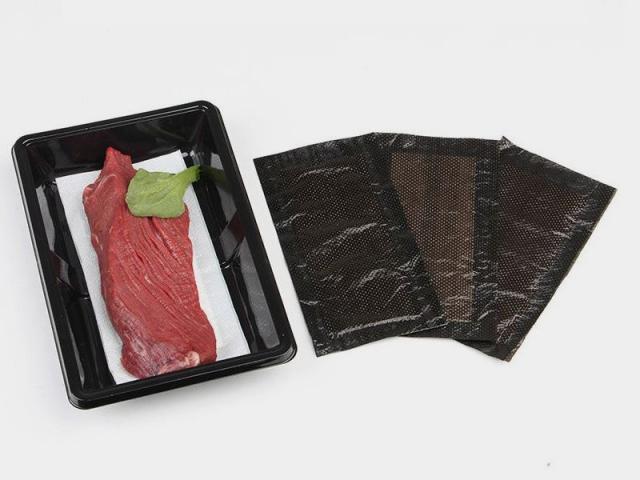
Choosing a meat soaker pad starts with four questions, not with an absorbency number: which tray you are filling, what cut of meat is going into it, how long the pack will travel, and who opens it at the far end. Answer those four and the pad's capacity tier and footprint largely pick themselves. This entry guide gives that first-pass method and routes each deeper question to its own page.
1. Let the tray format set the constraints
Before absorbency, the pad must physically fit the pack — each tray format narrows the options differently:
- Foam trays. A wide, forgiving base. The overwrap film is applied after the pad is in, so there is room to size up — the main risk is a pad that drifts and covers the meat or the label area.
- Rigid thermoformed trays. Often run under a heat-seal or skin film. The usable area is bounded by the sealing flange, so the pad must sit inside the seal zone.
- PP trays with a top film. The inner surface is slicker and purge pools at the lowest point; the pad should sit where liquid collects and must not ride up the tray walls.
- Gas-flushed (MAP) trays. The pad shares headspace with the gas, so its thickness and coverage matter as much as its capacity — the automation logic is covered in its own page.
2. A first estimate of how much it will bleed
Purge is the liquid a cut keeps releasing after slaughter — mostly water with dissolved protein. Its volume is driven by three things: the cut (a whole muscle gives less per kilogram than sliced, marinated or portioned product), how long the meat drains before packing, and its temperature history. For a first pass, sort the pack into three tiers:
- Light. Whole muscles or well-drained cuts on a short chill. The pad mainly has to manage the drip that appears late.
- Medium. Standard portion trays of beef, lamb or pork. A mid-capacity tier, with margin for the pressure of stacking.
- Heavy. Sliced or marinated cuts, high-drip product, or any chain long enough that condensate adds to purge.
A practical field check is to weigh a packed tray before and after chilling: the difference is the purge the pad has to hold. Rated absorbency is normally measured in clean water, which absorbs faster than protein-rich purge — treat a quoted figure as a typical range and confirm it with a purge test on your own pack before committing.
3. Size, margins and placement
Pad size is set by the tray's inner base, not its outer dimensions, and three rules keep the pack working:
- Centre the pad under the meat. No edge should rise and touch the film or lid.
- Keep the view clear. Stay out of any observation window and away from the label area.
- Stay out of the seal. On heat-sealed and skin trays the pad must never reach the sealing flange — a pad trapped in the seal line creates a leak that no absorbency rating can fix.
Turning tray dimensions into a maximum usable pad size is a repeatable measurement covered step by step in the tray-sizing guide.
4. A first-pass decision table
| Tray & cut scenario | Purge level | Pad tier to start from | Sizing note |
|---|---|---|---|
| Whole muscle on a foam tray | Light | Lower-capacity pad is workable | Smaller footprint fine; centre under the meat |
| Portioned beef / lamb / pork tray | Medium | Mid tier with stacking margin | Inner base minus margin |
| Poultry breast or thigh tray | Light to medium | Mid tier | Poultry purge runs early; keep the pad flat |
| Sliced or marinated portion | Heavy | Top tier, structure that locks | If the pack travels far, see the export guide |
| Case-ready or MAP tray | Medium to heavy | Shares headspace with the gas | Thickness and coverage matter; see the automation guide |
The table is a starting point only — the purge test on your actual tray decides the final tier.
5. Where this family goes next
This page only does the first pass. Every follow-up question has its own route:
- Packing on a case-ready, MAP or skin line — see the automated-lines guide.
- Running pads in a supermarket backroom — see the backroom guide.
- Shipping export or long cold chains — see the export guide.
- Need the exact tray-to-pad measuring method — see the sizing guide.
- Writing a spec or RFQ — see the spec-and-RFQ guide.
- Supplying both retail display and foodservice packs — see the display-versus-foodservice guide.
6. FAQ
Can one soaker pad cover different cuts of meat?
A single model can cover a range of cuts if its capacity sits above the heaviest purge you actually pack — sized to the heavy end, not the average. Because cuts bleed at different rates, test the lightest and heaviest pack in your range.
Will an oversized pad reach the heat-seal zone?
It can. On heat-sealed and skin trays the pad must sit inside the inner base and clear of the flange; a pad caught in the seal line leaves a leak path. Size to the inner base minus margin, then inspect the first sample run.
How do I know the absorbency is enough?
Not from a brochure. Run a purge test on your own tray: pack, chill, stack as the chain will, and check for liquid anywhere outside the pad. Adjust the tier until the tray base stays dry.
Is food-contact grade a minimum?
Yes. Every layer that can touch the meat must be food-contact compliant for your destination market — a baseline requirement, not a differentiator; the supplier should provide the declarations.
7. Browse the family
Our meat absorbent pads line is the meat hub; species pages cover poultry absorbent pads, beef absorbent pads and pork absorbent pads. Two sibling guides — sizing the pad to the tray and export and long cold chains — take the method further.