
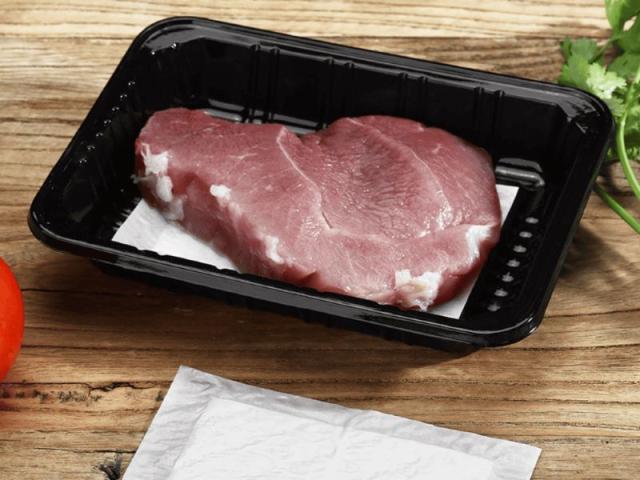
A spec sheet answers the supplier’s question; an RFQ should answer yours. The numbers on a meat pad datasheet — size, gram weight, absorbency, re-wet — are only useful once you know what each field really measures and which one your pack depends on. This guide translates the common spec fields into acceptance language, then shows what to put in an RFQ so three suppliers give you three comparable quotes instead of three different products.
1. Reading the spec sheet, field by field
Read these common fields with one question in mind: what does this number let me verify?
- Dimensions — length, width, thickness. The footprint tells you how it sits in the tray; the thickness tells you how much room it takes. Ask whether the thickness is the lofted or compressed value — a pad thick when measured flat may not be thick under product weight.
- Gram weight. Heavier usually means more absorbent material, but weight is not capacity. Compare gram weight only inside the same construction.
- Layer construction. The top web, core and back tell you more than any single material word; a pad described only as “SAP” is an incomplete story until you know what holds the granules and seals the bottom.
- The absorbency figure and its method. Many datasheets quote an immersion test, which measures uptake of water, not real meat purge. A pad’s uptake of salted purge is lower than its uptake of clean water, so treat the brochure number as an upper bound, not an acceptance value.
- The re-wet or weep definition. If a re-wet value is given, find the method behind it — pressure, time and liquid change the answer. A re-wet number without a method is not comparable to another supplier’s.
2. Food-contact and compliance fields
For food use you are buying layers that are legal to touch food in your market, not just absorbency. Read which layer materials are declared — top, core and back — and the food-contact basis they cite, such as the EU framework regulation with its plastics implementing measure, or the US FDA food-contact rules. Then ask for a written declaration of compliance from the supplier: it should state the basis it covers and the attached conditions, such as temperature and food type, because both change what is permitted. A brochure that only names a basis is not that statement.
3. Writing the RFQ: give the problem, not your guess
A useful RFQ hands the supplier your acceptance problem. The table below is a minimum set of fields:
| RFQ field | Why it matters | What the supplier can return |
|---|---|---|
| Tray details — inner base size, depth, material, drainage, seal or lid type | sizing is relative to the tray interior | a pad footprint proposal with clearances |
| Meat type, cut and pack weight | purge volume and character change with species and cut | a capacity band recommendation |
| Chain and temperature range — longest dwell, stacking, chill profile | no-weep and reserve needs change with the journey | a structure suggestion and a test recommendation |
| Volume, format and rhythm — sheets or rolls, monthly quantity | decides the format and lead time | format options and commercial terms |
| Sample and test requirement — purge test on your tray | turns a datasheet into an acceptance test | a sample offer and the test basis they will use |
If you are not sure which capacity band or size to ask for, decide that first: the purge logic for the cut is in the meat soaker pad guide, and the tray measuring method is in the tray-to-pad sizing guide.
4. Comparing quotes without tripping on the traps
The common trap is comparing unit prices across different capacity bands as if they were the same product. Before you compare, normalise the construction so each quote is the same core-and-web family, fix the absorbency band by asking each supplier to quote the band you specified, and fix the test basis. When one quote is much cheaper, check what changed — gram weight, layers, or the test behind the number — before treating it as a saving.
5. FAQ
Can I use the absorbency figure on the spec sheet as my acceptance value?
Usually not directly. Most datasheet figures come from a water-immersion test and overstate uptake of meat purge. Use the number to compare options, then set your own acceptance test on your product.
Should I ask for samples before a first order?
Yes. A first order without a purge-tested sample moves the risk onto your largest batch; a sample and a purge test are cheap next to a shipment of the wrong pad.
What should I ask about besides the MOQ?
Lead time, tooling or die-cutting cost, dimensional tolerance across batches, batch-consistency evidence, unit packing, and what happens if a batch comes up short on capacity. Also ask what test basis backs the absorbency figure.
The suppliers quote different test methods. How do I compare?
Ask each to run the same method, send one reference pad to a single test house, or have one supplier replicate another’s method. Numbers taken with different methods are different measurements.
6. Take it further
For the line to spec against, see meat absorbent pads. If a particular pack is hard to pin down in writing, contact us with your tray details and chain, and we will help you frame the RFQ around the test that matters.