
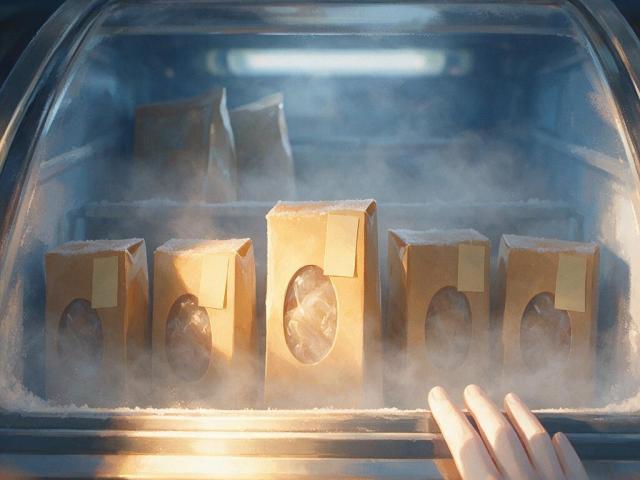
Cold-resistant labelling is decided by the adhesive, not by the facestock, and it turns on one distinction that is easy to miss: the temperature of the surface when the label goes on is a different specification from the temperature the label lives at afterwards. Applying to a frozen pack is far harder than applying to a warm one and then freezing. This guide separates the two, sets out where cold labelling fails, and gives a table for matching the adhesive to the order of operations.
1. The adhesive is the limit
- Facestocks mostly cope. PE and PP films, and most synthetic papers, stay flexible at freezer temperatures. A paper facestock can stiffen and crack, but that is the less common failure.
- Adhesives are what stop working. Pressure-sensitive adhesives get harder and less tacky as they cool. Below a certain application temperature the adhesive cannot wet the surface at all, and no amount of pressure fixes it.
- A label can look fine and still be wrong. One applied cold may appear stuck, then lift at the edges once the pack is handled or the surface warms and contracts.
2. Two numbers, not one
Every cold-chain adhesive carries two ratings, and they are quoted separately for a reason.
- Minimum application temperature. The coldest surface the adhesive can be applied to and still bond. This is the number that decides whether the line can run.
- Service temperature range. The range the bond tolerates afterwards, including storage and transport.
- A wide service range does not imply a low application temperature. Many adhesives rated for −40 °C storage still need to be applied above freezing.
Ask for both, with the substrate named. The application figure also depends on the surface — a cold, condensated film is harder than a cold, dry one. Where the label is thermal printed, the print is a third variable rather than a fourth rating: a bond that holds is no use if the barcode will not scan, and a cold surface changes how the print forms. See thermal label paper for the cold-chain print side.
3. Choosing by order of operations
| When the label goes on | Surface temperature | Adhesive | Facestock | Where it lifts |
|---|---|---|---|---|
| Warm pack, then frozen | ambient or above | standard permanent with a freezer-rated service range | paper or film | edges, as the pack contracts in the freezer |
| Directly onto a frozen pack | below freezing, dry | low-temperature, high-tack | PE or PP film | immediately; the adhesive cannot wet a cold surface |
| Repeated freeze-thaw | cycling | flexible, low-modulus permanent | flexible film, not paper | corner lift after several cycles |
| Cold and condensated | below freezing, wet | wet-surface, low-temperature | film | at application; moisture blocks the bond |
Adhesive families above are directions rather than fixed choices. Where the pack is also washed or rained on, the wet-surface question overlaps — see waterproof labels. For the facestock side of cold work, PE film labels are the conformable, cold-tolerant option.
4. Common misapplications
- Quoting the service range as if it were the application range. A −40 °C service rating says nothing about whether the label can be applied in a −5 °C room.
- Applying cold and blaming the facestock. When a label falls off a frozen pack, the facestock is almost never the reason.
- Ignoring the container material. Low-energy plastics and condensation both reduce adhesion, and a frozen PE bag is a harder surface than a frozen tray.
- Forgetting the thaw. Some bonds hold when cold and fail as the pack warms and the substrate expands at a different rate from the label.
FAQ
What is the lowest temperature a label can be applied at?
It depends on the adhesive, and the figure is quoted per substrate. Ask for the minimum application temperature rather than the service range.
Can paper labels be used on frozen packs?
They can where the pack is labelled warm and then frozen. Applied to a cold, damp surface, paper stiffens and the bond is unreliable.
Why do labels lift at the corners after freezing?
The pack contracts more than the label does. A flexible film with a low-modulus adhesive follows that movement; a stiff combination does not.
Does an overlaminate help in the cold?
Not with adhesion. A laminate adds stiffness and protects the print, which can make corner lift worse on a curved or flexible pack.
Browse the range
Start from the cold-resistant labels range, or the wider functional labels group covering waterproof, flame-retardant, anti-static and anti-counterfeit options. Send the application temperature, the storage temperature and the surface, and an adhesive can be matched before samples are issued.