
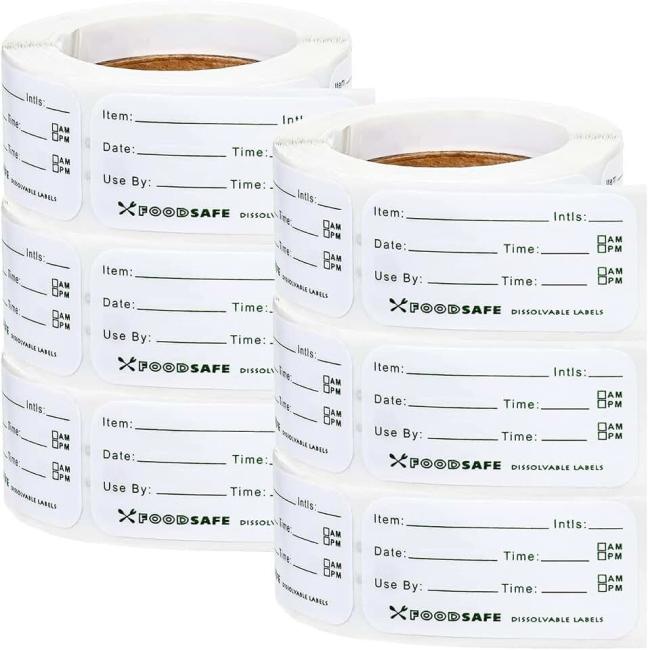
- Face: selected water-dispersible label stock
- Adhesive: matched to the surface and defined water-based removal
- Purpose: temporary information on a confirmed reusable item
- Print route and roll or sheet format: grade and equipment-specific
- Use/storage and washing: temperature, time, agitation and detergent stated
- Dimensions, layout, acceptable residue and supporting material requirements: agreed to order
Typical converting options
- Core: 25.4 mm (1″), 40 mm or 76 mm (3″), matched to the applicator
- Face weight: 70–90 gsm dissolvable paper, typical range
Dissolvable labels are selected for temporary information that must be cleared during a defined water-based cleaning step. Candidate uses extend beyond kitchens to reusable storage, inventory, production containers and service operations.
Confirm the water-dispersible face and adhesive, then test both the period of use and the wash sequence. The product name is not a promise of instant disappearance, zero residue, food-contact suitability or performance in every wash process.
Applications and Evaluation
- Reusable storage bins and trays: temporary content, location or status information.
- Production containers: batch and work-in-progress identification removed between cycles.
- Retail and service containers: changing contents or inventory information before reuse.
- Hospitality and food preparation: dates and contents on a confirmed reusable-container surface.
- Sample and general-purpose organisation: assess the required readability and wash removal for the specific task.
Compare the related material and printing routes below.
Key Features
Match the intended use and wash step
Record how long the label must read, its storage exposure and when it should release. Moisture resistance during use and dispersion during cleaning are different requirements.
Test water conditions and residue
Specify water temperature, time, agitation, detergent and any rinse and drying steps. Inspect remaining face and adhesive on the actual surface; do not assume a fixed dissolution time or a residue-free result.
Select the actual print construction
Direct-thermal rolls and printable sheets require different media and equipment checks. Confirm the grade, printer, sensing or sheet path, then evaluate the printed sample through use and cleaning.
Distinguish the end-of-use mechanism
Water-dispersible labels, peel-removable labels and wash-off recycling constructions are different routes. Dispersion alone does not demonstrate biodegradation, compostability or a package recycling outcome.
Technical Specifications
The Specification section lists the agreed supply options. Confirm the following before approving a grade.
- Face, adhesive and print are identified for the proposed dissolvable construction.
- Use conditions and water-based removal conditions are specified separately.
- Acceptance covers readability before washing and remaining material after the full cleaning sequence.
Custom requirements are assessed against the proposed construction and a reference sample.
How to Select and Order
A dissolvable label is defined by the wash, not by the material. Each part below says what it decides, the options available, and what we need from you.
1. Face stock — decides what is left after the wash
Water-dispersible paper face stock.
What we need from you: What dissolved has to mean for you: no visible label, no adhesive residue, or no paper fibre at all. These are three different targets.
2. Adhesive — decides whether it releases or smears
Water-based dispersible adhesive matched to the removal route.
What we need from you: The surface: stainless steel, plastic or glass. The same adhesive behaves differently on each after a wash cycle.
3. Liner
Standard glassine liner.
What we need from you: Your applicator type and the format you handle.
4. Service conditions — the wash defines the product, not the material
We do not claim dispersion under conditions we have not tested. A label that disperses in 40 °C water with agitation may leave adhesive residue in a still tank at 20 °C.
What we need from you: Water temperature · soak time · agitation · detergent or sanitiser used · the container material · what counts as acceptable residue. Not suitable for every container — confirm against your actual wash process before specifying.
5. Printing and converting
Print route and format agreed for the order.
What we need from you: Whether the label is printed before or after washing. Direct thermal printing is affected by the wash cycle.
Before the order runs
Use a two-stage sample brief for temporary labels on reusable items:
- In-use stage: identify the item, surface, information, print method, required reading period and exposure to moisture or handling. Include the intended inventory, production or foodservice task.
- Cleaning stage: record actual water temperature, detergent and concentration, wash duration, agitation, rinse and drying steps. Confirm the proposed face and adhesive grade.
- Acceptance: agree attachment and readability before cleaning, then the acceptable remaining face, ink and adhesive after the complete cycle. Photograph the same sample IDs before use, before cleaning and after drying.
- Reuse check: inspect the item surface and try the next label on a cleaned item where relevant. Keep separate results for each container material and cleaning process.
Water dispersion is not evidence of compostability, recycling wash-off performance or suitability for direct food contact. Confirm those requirements separately for the intended construction and use.
Send the artwork, surface, equipment and quantity to request samples and confirm the construction.
Related: Waterproof Labels · Paper Labels · Eco Labels · White Thermal Labels · Direct thermal and thermal transfer printing
FAQ
Are dissolvable labels only for kitchens?
No. Temporary inventory, reusable storage and production-container tasks can also be considered. Suitability depends on the selected grade and the actual use and cleaning conditions.
Will every label disappear in any water temperature?
No universal time or temperature is implied. Confirm the grade and trial the specified water, detergent, agitation and cycle on the actual surface.
Does dissolvable mean compostable or wash-off recyclable?
No. Those are different mechanisms and claims requiring their own construction, conditions and supporting information.
Can the label be used on a food or laboratory container?
Confirm the actual task, contact conditions and any relevant material requirements separately. A dissolvable face does not establish suitability for direct food contact or a critical sample-identification process.