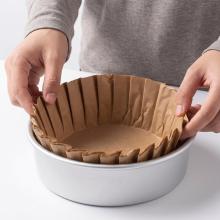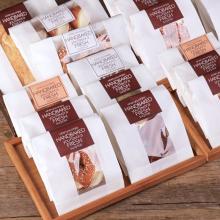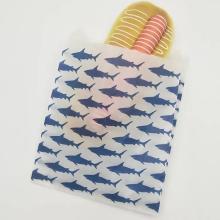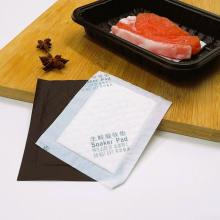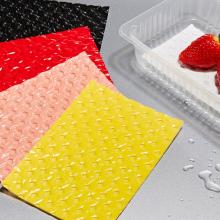
A food-contact pack is rarely a single material. It is a small system: the paper that touches the food, the bag that carries it, the label that identifies it, and the pad that manages what the food releases. Buyers who source those four families from one partner spend less time reconciling specifications across suppliers - and far less time on the mismatch that only becomes visible once the goods are already packed.
Which Family Carries Which Role
Before comparing grades, it helps to separate the four families by the job each one actually does in the pack.
- Baking and food paper - the sheet, liner or wrap that sits between the food and the oven, steamer or tray. Grease resistance and heat tolerance are the two properties that decide whether it holds through the process.
- Greaseproof and parchment bags - here the bag itself is the food-contact surface. Barrier, seam strength and closure decide whether the portion travels without marking the outer pack.
- Label materials - face stock and adhesive have to survive the same conditions as the pack: condensation, light refrigeration, occasional contact with oil or moisture.
- Absorbent pads - for fresh protein, produce and seafood, the pad manages drip inside the pack so the outer surface stays presentable through the cold chain.
See the four families in context on the baking and food paper, eco paper bags, eco labels and fresh absorbent pads hubs.
What to Settle in the Specification
- Which surface actually touches the food. In a lined bag or a tray with a sheet, that is one material, not two. Naming the contact surface up front prevents a whole class of later disputes.
- Temperature range end to end. Oven, steam, blast freezer, display case - the widest point in the route governs the choice, not the average.
- Barrier expectation, stated as a test rather than a claim. Agree how grease resistance will be checked at the temperature actually used, and at what contact time.
- Format. Sheet size and shape, bag dimensions and gusset, label die-cut, pad dimension and absorbency - each expressed in the unit your line actually consumes.
- Printability. Whether the pack is expected to carry branding, and with which ink system, since that constrains the substrate choice.
Where Food-Contact Packs Go Wrong
- Specifying the paper and the bag as separate purchases. The two are chosen independently and then fail together, usually at the seam or the fold.
- Treating "greaseproof" as one grade. It describes a behaviour, not a number. Two suppliers can both say greaseproof and still behave differently at the same temperature.
- Choosing the label last. Adhesive is the part most sensitive to the pack's real conditions, and it is the hardest to change after the run has started.
- Leaving condensation out of the brief. A pack that performs dry can still fail in a display case, where the surface it is bonded or printed on is wet.
FAQ
Does food-contact paper always need a coating?
No. Some applications are met by the base sheet alone, particularly where contact time is short and the food is not hot and fatty at the same time. A coating extends the working window; whether you need that extension is a question about the process, not about the paper.
Can one supplier realistically cover all four families?
Yes, and that is the practical argument for sourcing them together: the four are specified against the same process conditions, so the useful comparison is between their combined behaviour, not their individual data sheets.
How do we compare grease resistance between two samples?
Fix the variables first - temperature, contact time, and the food type - then compare under those fixed conditions. A comparison run at different temperatures tells you about the test, not about the material.
What should a quotation include for a food-contact pack?
Material and grade, contact surface, dimensions, temperature range, printability, and packing format. If any of those is left implicit, the quoted price is not comparable with the next one.