
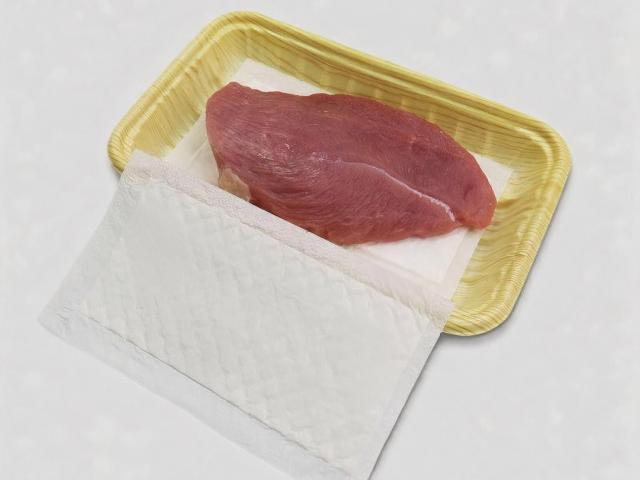
"Food grade" is not one standard and not one document. An absorbent pad sold into the EU, the US and China is judged against three different rule sets, and the paperwork a buyer has to hold differs in each case. This guide maps which rules apply in each market, what to ask for before an order, and where the direct-contact question changes the answer.
1. The pad is a food contact material, and that is the whole legal question
An absorbent pad sits under or beside food. Where it can transfer constituents into the food — by contact, drip or vapour in a sealed tray — it is regulated as a food contact material, not as packaging.
- Direct contact. The pad touches the food, or liquid passes through it. The tightest limits apply.
- Indirect contact. A barrier film separates them, or the pad meets only the outer wrap. Fewer requirements, but they do not disappear.
- Contact type drives the limit. Fatty and aqueous foods are assessed differently from dry ones, which is why a pad specified for meat is not automatically cleared for a dry line.
Establish which of the three the pack is before asking for documents — the answer decides which exist.
2. The three rule sets
- EU. Framework Regulation (EC) No 1935/2004 sets the general safety and inertness principles, and Regulation (EC) No 2023/2006 sets the GMP requirements for the chain. Paper and board has no harmonised EU measure, so the destination member state's own rules also apply; the Cepi GMP Guideline is the sector's advisory route to demonstrating it.
- US. Components are cleared as indirect food additives under 21 CFR Part 176 — §176.170 for aqueous and fatty foods, §176.180 for dry. A new substance goes through a Food Contact Substance Notification; an FCN is effective only for the notifier and their customers.
- China. GB 4806.1 sets the general safety requirements, and GB 4806.8-2022 covers paper and paperboard in contact with food, effective 30 June 2023, replacing the 2016 edition. Additives follow GB 9685.
3. What to ask for, by market
| Market | Rules that apply | Declaration expected | What to request | Status |
|---|---|---|---|---|
| EU | 1935/2004 framework; 2023/2006 GMP; national measures | declaration of compliance, passed down the chain | a declaration for the finished pad; the migration data behind it; the destination state's rules | framework and GMP in force; paper and board not harmonised |
| US | 21 CFR Part 176; FFDCA 409(h) for new substances | no standard declaration; a supplier statement citing the sections | the CFR section each component is cleared under; the FCN number and notifier where applicable | in force |
| China | GB 4806.1; GB 4806.8-2022; GB 9685 | statement against the applicable GB standard | the standard the pad is made to; its migration data | GB 4806.8-2022 in force since 2023-06-30 |
| Other markets | national schemes, often modelled on one of the above | varies | the destination's own requirement, in writing | confirm per market |
Two details cause most delay. A declaration follows the material through the chain — the converter's statement rests on the paper, film and adhesive suppliers' own — so asking late rarely works. And an FCN in the US is tied to the notifier: a component cleared for one supplier is not cleared for another.
Where the pad is designed to break down after use, compostability and disposal are separate questions from food contact — see biodegradable absorbent pads.
4. What the documents do not cover
- They do not cover a change of material. A declaration applies to the construction it was written for; substituting a film or adhesive invalidates it until reissued.
- They do not cover misuse. A pad assessed for chilled contact may not suit a hot fill or an ovenable pack.
- They do not travel by default. A statement for one destination may cite another market's rules; check the market, not the folder.
- They are not a performance claim. Compliance says nothing about absorbency, and absorbency nothing about compliance. The two are specified separately.
FAQ
Is a "food grade" label enough?
No. There is no single food grade — only market-specific rules, and a pad has to satisfy those of the market it is sold into.
Does the pad need assessment if the food never touches it?
It depends on the barrier. With a full film barrier between pad and food the contact is indirect and the requirements are lighter — but the barrier itself becomes the food contact material.
Which market has the strictest rules for paper pads?
China has a dedicated mandatory standard for paper and board in food contact. The EU relies on the framework plus national measures, the US on the indirect additive listings. Which is hardest in practice depends on the food type and contact conditions.
How long does the paperwork take?
It depends on whether the supply chain already holds the underlying statements. Where they exist, a declaration assembles quickly; where a material must be re-documented, it can add weeks.
Browse the range
Start from the pads used with poultry trays, where the same direct-contact question meets a wetter product, or seafood absorbent pads for the wettest case. Send the destination market, food type and whether a barrier film is present, and the document set can be confirmed before samples are issued.