
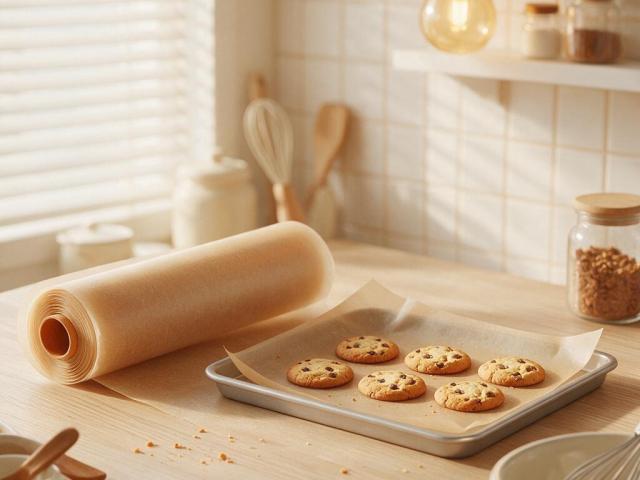
Vegetable parchment is a paper made greaseproof and heat-stable by a chemical process, not by a coating. In the parchmentising step the sheet is rushed through a strong-acid bath, most often sulphuric acid, which swells the cellulose fibre and closes the web into a dense, translucent sheet that resists oil on its own. That is why the word "parchment" on a label tells you almost nothing: it is safer to order the material by four numbers — grammage, heat in peak and continuous figures, a grease-resistance grade, and a food-contact declaration. This guide names the four, then shows how to pin each one down with a supply partner instead of trusting a brand name.
Why the process, not the name, sets the sheet
Parchmentising works by fibre fusion. Passing the base web through the acid bath softens the outside of each fibre, and the surfaces bond together as the acid dries off, closing the pores that would otherwise let oil and water through. The result is a grease-tight, glassy-smooth web with a characteristic rattle when rubbed. Because the resistance is manufactured into the web rather than painted on, a control-led batch behaves consistently run after run.
The four audit numbers
Order parchment the way you would order any engineered material — with four verifiable numbers rather than a product name. Each is a range you confirm by a batch test, not a marketing slogan.
- Grammage. The weight of the web sets how it drapes, creases, folds and holds its shape in a former or mould. A lighter grade pleats, a heavier grade stands up to being die-cut.
- Heat, in two figures. You need a peak number for the hottest moment and a continuous number for a long hold, each with the oven or test method that produced it. One figure is not a spec.
- Grease resistance grade. A graded result on the Kit-type scale, matched to the oil load of your product, rather than an ungraded "anti-oil" claim.
- Food-contact declaration. A written statement that the grade suits direct contact under the rule that governs your destination market, with the standard named.
How to interrogate a supplier on the four
Ask for answers you can audit:
- Grammage in gsm, plus the caliper if your former is finicky.
- Peak and continuous temperature with the test standard used for each.
- The grease Kit figure and the method that scored it.
- The exact food-contact declaration and the market it is issued for.
A seller who returns all four figures with test standards in a single reply is easier to audit than one who leads with a brand. Range-based, method-backed numbers are the entire reason to specify in the first place.
Two decisions that change the number
The four numbers are not fixed constants; two of your routine choices shift them, and it is worth deciding them before you lock any sheet in.
- Fresh-from-mould release vs long contact. A sheet that only separates food after a short bake can run a lighter grammage; one that carries a sticky, oil-rich load for a long, slow cooking cycle deserves a heavier web and a firmer fusion level.
- Roll vs pre-cut. If your tray and mat widths are standardised and stable, pre-cut sheets cut labour and scrap; a wide roll suits mixed dimensions and frequent changeovers.
Roll, sheet or die-cut — how the material is supplied
| Supply form | Best for | What to confirm |
|---|---|---|
| Jumbo / master rolls | Converters and high-volume lines that will slit or punch in-house | Ends, splices, width tolerance, unwind direction |
| Pre-cut sheets | Standardised trays, mats and sheet-fed runs | Squareness, corner radius, pack count |
| Die-cut and folded | Moulds, pouches and formed liners | Fusion strength under wet handling, fold memory |
Match the form to the station that consumes the paper, then reconfirm the four numbers on that exact form — the slit or the die can change how the sheet behaves in your machine before you ever load it.
Where the four-number habit pays off
Two routine upsets are avoided by specifying by number. A substitute that looks identical but was parchmentised at a lighter fusion level will oil-bleed under a genuinely oily product — the graded figure would have flagged it. And a sheet pulled straight from a freezer and baked loses water if it was bought on a single peak number; the continuous figure tells you whether it can sit un-spliced through a long dry cycle. When a number does not match, change the number — not the faith you put in the word "parchment".
FAQ
Are vegetable parchment and baking paper the same thing?
In most food-service use, yes: baking paper is the common, application-side name for vegetable parchment used with heat. Specify the material and the four figures, not the label that names it.
Do I need a separate food-contact statement per market?
Yes. Ask for a declaration written for the regulation of the market you ship to (for example the EU or FDA frameworks), and keep the supplier's written statement with your batch records.
Why does the furnish flux give me two heat figures?
Peak and continuous describe different exposure. A quick high-heat pass is fine for many grades; a long, low-temperature hold asks for the continuous rating, which is where most inconsistencies quietly live.
How do I tell parchment quality by hand?
Rattle it and bend it — a parchmentised web is stiff and papery-thin with a dry, rustling crease. But treat your hand as a screen only; the four audit numbers are the decision, a texture check is not.
Browse the range
Vegetable parchment in rolls and sheets is under vegetable parchment paper, and the wider line — ovens to release — starts at baking and food paper.