
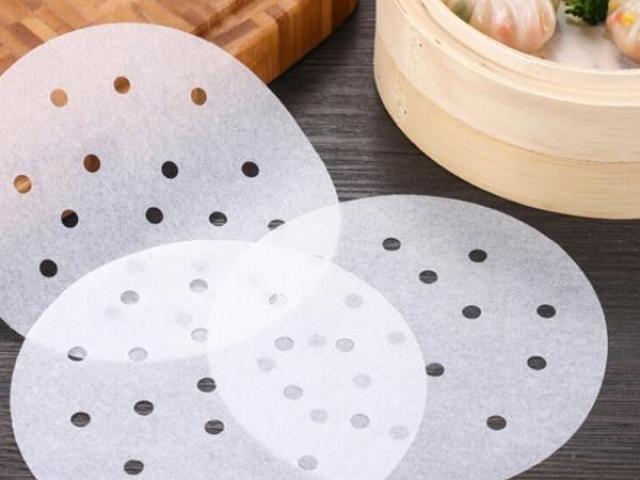
Steaming is a different world from baking. Inside a bamboo or metal steamer the liner works at boiling point (~100 °C at standard atmospheric pressure) in humid, condensing steam — not dry oven air. Its jobs are the same two as any tray liner (stop sticking, keep the food off the rack), but the failure modes are not: a paper that shrugs off 230 °C dry heat can still soften, split or glue itself to a dumpling when it is wet and hot. Most kitchens do not buy in paper-type names ("silicone-coated", "parchmentized", "greaseproof"); they buy in jobs — round sheets that fit my bamboo steamer, sheets that survive a wet batch without tearing, a liner my supplier can ship by the carton. This guide walks the choice that way, then gives you the spec points to verify so the sheet matches your steamer, your product and the market you sell into.
1. One job, several names: what "steamer liner paper" actually is
Walk into five food-service suppliers and the same-looking round sheet will be called steamer paper, dim sum paper, bamboo steamer liner, or just "the paper we use in the baskets". Under the names sit a few real choices — including some that are not paper at all:
| Choice | What it is | Release / behaviour in steam | Where it fits |
|---|---|---|---|
| Silicone-coated (non-stick) paper | Base paper with a silicone coating on one or both sides | High release; sheds water and steam condensate well; stays intact through a wet batch | The commercial mainstream for round dim sum liners and reheat-from-frozen formats |
| Parchmentized paper (true vegetable parchment, uncoated) | Acid-treated dense cellulose; no coating | Good release with low chemistry; high wet strength and grease resistance | The "uncoated" pick where you want no coating and heavy wet/grease duty |
| Greaseproof paper | High-beat-refined dense pulp (fibre-based) | Moderate release; a good oil barrier, but a lower wet/heat ceiling | Wrapping and interleaving jobs, not long wet steaming |
| Non-paper options: cloth, silicone mats, bamboo leaves / cabbage | Fabric, cured silicone, or leaf | Each has its own release and reuse story (see section 3) | Traditional or reusable setups; not usually a spec'd converted-paper product |
Why it matters: "bamboo steamer liner" in a restaurant-supply catalogue is very often silicone-coated paper pre-cut to a circle. If a supplier calls it "parchment" but it is coated, release, price and end-of-life all change. The spec sheet should say which family you are buying.
Browse the families as product pages: silicone-coated parchment paper, vegetable parchment paper and greaseproof paper.
2. What the paper is doing in there (and why steam changes the rules)
- Release: cooked starch and protein are sticky when hot. The liner is what lets a siu mai or bao lift cleanly off the bamboo slats without tearing.
- Wet strength: this is the big one. Steam condenses on the sheet and drips back; a liner that is not wet-strong softens, splits or comes apart mid-batch. Oven papers are not necessarily wet-strong — that is the spec point people miss when they grab "baking paper" for the baskets.
- Clean separation: the sheet keeps food off the rack/basket and makes washing faster.
- Condensate behaviour: a coated sheet sheds water instead of absorbing it, which matters for the bottom of the bun — see the FAQ on soggy bottoms.
Signs of a bad buy: the sheet tears when you lift a hot dumpling; it fuses to the food; it smells or discolours in the basket; one-side-coated rolls with no clear "which side up" mark cause inconsistent release; sheets whose circle is smaller than the basket let food drift onto the bamboo. These are spec problems, not bad luck.
Food-safety handling: a fresh liner per basket is the dine-in standard — single-use paper is part of cross-contamination and allergen control for kitchens that answer to an inspector or an audit. If you do reuse heavier liners within a shift, keep it to the same product and never let a sheet touch raw meat or fish and then go back under cooked food. Reusable cloth and mats shift that same responsibility to your laundry and wash routine.
3. Paper or something else? A quick routing for the whole "liner" family
Steaming predates paper liners, so the honest comparison list is short:
- Woven cotton cloth — classic, reusable, but it must be kept damp, laundered, and it can stick to wet dough; hard to control consistency at volume.
- Silicone baking/steaming mats — reusable, high release, but a different price point and a cleaning habit; popular in home and low-volume kitchen use.
- Fresh leaves (bamboo, banana) or cabbage — traditional for specific dishes; flavour transfer and labour make them a dish choice, not a line spec.
- Paper liners (this guide) — consistent, single-use, spec'd to size and duty, easy to buy by the carton and to QC. This is what most volume operations standardise on.
None of these is "better" in the abstract — the decision is speed and consistency (paper), reuse (cloth/mat), or tradition/flavour (leaf). Section 4 routes by your actual steamer and product.
4. Which liner for which steaming job (a decision table)
Start from the basket and the product, not the name:
| Steaming job | Suggested choice | Notes |
|---|---|---|
| Bamboo steamer, dine-in dim sum (fresh, one basket at a time) | Pre-cut round, silicone-coated | Order to your basket's inner diameter with a little extra so the sheet cups the wall and holds its place; coated side is the food side |
| Stainless perforated trays / hotel pans in a combi or box steamer (central kitchen, catering) | Flat sheets or roll, cut to tray — wet-strong coated or parchmentized | Larger footprint and stacked loads mean tear resistance matters more than circle shape |
| Frozen dim sum steamed straight from the freezer (factory demo, food-service reheat) | Coated round liners or sheets, higher wet strength | Ice melt + steam is the harshest condensation case; confirm wet strength, not just release |
| Holding / display over steam (bao warmers) | Coated paper, sized to the well | Long humid exposure; the sheet must not delaminate after an hour over steam |
| Interleaving frozen product in boxes before steaming (buns, dumplings, patties) | Coated or greaseproof interleaving sheets | A freezer/transport job, not a steam job — separate the pieces so they do not fuse in the box |
Typical ranges to sanity-check a spec: basis weight roughly 30–60 gsm for most food liners — single-use round sheets often run lighter, reuse-heavy or large-tray formats heavier. Exact performance (wet strength, release, migration scope) is a batch-sheet question, not a brochure claim.
5. Sizes and formats: what you actually order
Steamers and dim sum come in a handful of shapes; the liner should match the basket, not the other way around:
- Round liners for bamboo baskets. Bamboo steamers are commonly sold around 8 / 10 / 12 inches (≈ 20 / 25 / 30 cm) — order to your basket's inner diameter, and confirm whether the supplier's circle is sized to the flat inner base or to cup the wall (some kitchens want the sheet to hug the side so food does not slide off the edge).
- Rolls / flat sheets for metal trays, hotel pans and combi-steamer racks — cut to tray size at the kitchen or supplied slit to your rack width.
- Perforated sheets where you want more steam pass-through (some high-moisture products) — a spec option to ask about, not a default.
- Bulk / custom: carton quantities, die-cut circles at tighter tolerances, printed or branded liners for retail bakery presentation.
Format is where a converter — or a trading supplier coordinating one — earns the order: accountable for circle size, GSM, edge and packing QC on the converted product. Ask directly who cuts and inspects, and what tolerance they hold. (Many specialist suppliers work with a small group of converting plants they know well — that cooperation is normal and is exactly the point of asking.)
6. Food contact: the regulatory map (and how to verify for wet, hot contact)
A liner touches hot, moist, often fatty or starchy food directly, so "food grade" needs a scope, not a label. The landscape (general knowledge — a specific batch report belongs in the supplier conversation, not in a blog):
- EU: Regulation (EC) No 1935/2004 is the framework. Coated layers can bring specific measures (e.g. (EU) No 10/2011 for plastics-type coatings and their migration requirements — whether a given coating falls under a plastics measure depends on the coating system and how it is declared); for paper and board, BfR recommendations (notably BfR XXXVI) are the widely used industry benchmark.
- US: FDA 21 CFR covers food-contact substances — §176.170 for components of paper/paperboard contacting aqueous and fatty foods. A Declaration of Compliance is the normal B2B evidence.
- Verify for your condition: a report that only covers dry-room-temperature contact may not reflect hot, humid, condensing steam. Ask for an accredited-lab test whose scope covers the food type and contact condition you actually run (aqueous/hot, fatty, or both), plus a written statement that the shipped batch matches the tested product. Keep one copy in your file — it is often the document that lets you pass your own customer's food-safety check.
7. Spec'ing an order: the checklist that cuts weeks of back-and-forth
- Format first: round diameter (to which part of the basket) / sheet or roll size / perforated or not / carton pack.
- Then the family: silicone-coated vs parchmentized vs greaseproof — written on the sheet.
- Then weight and finish: GSM, colour (natural/white), one- or two-side coating if coated.
- Then performance data: release behaviour, wet strength (tensile when wet — the steam spec), grease/oil method + target, migration/regulation scope for wet+fat contact.
- Then logistics: MOQ per size, lead time, FOB/EXW port; ask for a pre-production sample of the exact converted format (the real circle size and coating, not a generic roll) and a retained sample at shipment.
- Agree quality-at-arrival: what is inspected on arrival (diameter, GSM, coating consistency, edge), and the remedy if it drifts.
8. FAQ
What paper do you put in a bamboo steamer?
A pre-cut round liner sized to the basket's inner diameter — most commercial kitchens use silicone-coated (non-stick) paper; parchmentized paper is the uncoated alternative where you want no coating.
Is steamer paper the same as baking paper?
They share paper families, but the jobs differ. Steaming is wet and ~100 °C at standard atmospheric pressure (higher only if you use a pressurised commercial steamer — then spec to the equipment's limit); the spec that matters is wet strength, not dry-heat tolerance. Baking paper for the oven is not automatically the right sheet for the baskets — check wet strength and contact scope.
Which side of the liner faces up?
For one-side-coated sheets, the coated side is the food/release side; most brands mark it. Two-side coated removes the question.
Why are my dumplings sticking or going soggy on the bottom?
Usually trapped condensation or the wrong release side rather than the "wrong paper". Check: coated side up, steam can circulate (basket gaps not sealed by an oversized sheet), and cooking time — then test a perforated or higher-release sheet if it persists.
Does the liner block the steam?
A sheet that fully seals the basket base can slow steam reaching the food. Standard practice leaves the sheet slightly smaller than the rim or lets steam rise around it; perforated sheets exist where more pass-through is wanted.
Can steamer paper be reused?
Some heavier or two-side-coated liners tolerate more than one light batch, but release and wet strength degrade — treat reuse as a case-by-case decision, not a promise, and never reuse a sheet that has touched raw meat or fish.
What size liner fits my steamer?
Measure the basket's inner diameter (common bamboo sizes run ≈ 20 / 25 / 30 cm / 8–12 in) and tell the supplier which part the circle must fit — flat base, or cupped against the wall.
Paper, cloth, silicone mat or leaves — which is best?
Each has a place: paper wins on consistency and speed at volume, cloth/silicone on reuse, leaves on tradition and flavour. The decision table in section 4 routes by your steamer and product.
9. Comparing sources?
If you are sourcing steamer or dim sum liner paper — round sheets, perforated, bulk or printed — send the six-point checklist from section 7 and get sizes, data and a pre-production sample of the exact format you steam.
To see how steamer papers fit a wider food-service range, browse our Baking & Food Paper range. For oven and tray applications, see our related guide on baking tray paper for ovens and baking trays.
Request a Quote for Steamer / Dim Sum Liner Paper — our sourcing team takes inquiries and samples as part of the normal trade flow.