
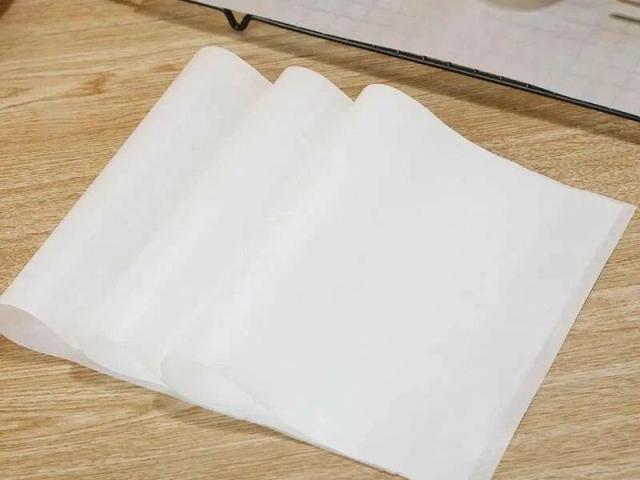
The sheet under your bakes does three jobs at once — it stops sticking, holds back grease, and separates food from the metal. Most bakers do not think in paper-type names ("parchment", "siliconized", "greaseproof"); they think in jobs: Will my croissants release? Can this go to 230 °C in a convection oven? Is it okay in direct contact with food? This guide answers it the same way — by application — then gives you the four numbers to verify so you never buy on adjectives again.
1. One job, several names: what "baking tray paper" actually is
Walk into five suppliers and the same-looking sheet will be called baking paper, parchment paper, oven liner, or siliconized paper. Under the names sit three technical families. Knowing which family you are holding answers most questions before you test:
| Family | How it is made | Release story | Character |
|---|---|---|---|
| Parchmentized paper (true vegetable parchment) | Base paper passed through a sulfuric-acid bath that densifies the cellulose | Moderate release, from the dense sheet itself | No coating; high grease resistance and wet strength; the "low-chemistry" choice |
| Silicone-coated baking paper | Base paper with a silicone coating on one or both sides | Very high release | Higher release, has a coating layer; many retail non-stick "baking paper" rolls are coated — some silicone-based, some silicone-free (see note below) |
| Greaseproof paper | High-beat-refined dense pulp (fibre-based) | Low–moderate release | Good oil barrier for wrapping; lower heat/wet ceiling than parchment |
Why it matters: "parchment paper" is sometimes used loosely for the silicone-coated product. If a supplier says "parchment" but it is coated paper, the release, cost and end-of-life story all change. The specification sheet should state which family you are buying.
One more shelf distinction: not every coated baking paper is silicone — some converters use silicone-free release coatings (quilon-type and other systems) for cost, formulation or end-of-life reasons. "Non-stick" tells you the job, not the chemistry. If release consistency, recyclability or a customer's coating policy matters, ask which coating system is actually on the sheet.
Browse the families as product pages: vegetable parchment paper, silicone-coated parchment paper and greaseproof paper.
2. What the paper is actually doing (and what cheap paper gets wrong)
- Release: the liner lets you lift the bake without greasing the tray — or scraping it.
- Grease hold: in trays with butter, oil or rendered fat, the sheet keeps the tray clean and the bake from frying onto metal.
- Heat behaviour: a decent liner stays stable at oven temperature; it should not turn brittle, brown-spot or smell.
- Food contact: the liner touches food directly — see section 5 for what to verify.
Signs of a bad buy: silicone layer peeling after one tray; sheets that curl or tear when wet; dark spots or an odour at 200 °C; rolls whose width drifts so your line jams. These are usually specification problems, not bad luck.
3. Which paper for which bake (a decision table)
Start from the tray and the product, not the name:
| Application | Suggested family | Notes |
|---|---|---|
| Cookies / biscuits, tray after tray | Silicone-coated or parchmentized | High release saves labour on repeated trays; heavier GSM if re-used within a shift |
| Bread / baguettes on steel or stone | Parchmentized (or greaseproof if brief) | Needs wet strength if dough is wet; stone ovens need heat stability |
| Croissants / laminated pastry | Silicone-coated | Aggressive release for butter-heavy pastry |
| Cakes — tin liners, sheet separators | Parchmentized or coated | Cake circles/side strips often die-cut |
| Roasting trays (meat, vegetables) | Parchmentized, higher GSM | Juice + high heat; heavier sheet survives the roast |
| Bake-from-frozen (croissants, puff pastry, dough pieces straight to a hot oven) | Silicone-coated | Frozen surface meets dry heat; high release plus even thaw on the sheet |
| Interleaving stacked product (hot-dog rolls, patties) | Silicone-coated or greaseproof sheets | Layer separation in boxes, freezer-to-oven direct |
| Wrapping (bakery bags, takeaway) | Greaseproof | Barrier wrap job, not an oven job |
And the non-paper alternatives — foil, silicone mats, cloth: aluminium foil survives the same heat but adds no release and blocks air under the bake, which can slow even browning; reusable silicone baking mats give consistent release but add a cleaning habit and a different upfront cost; washable baking cloth suits artisan loaves and bench work, not repeated sheet trays. Paper liners win on consistency, speed and line hygiene for tray-after-tray work — most volume bakeries standardise on them and keep foil and mats for specific jobs. If you are weighing paper against a reusable option, compare per-bake cost and your cleaning line, not just the sheet price.
Typical ranges to sanity-check a spec: basis weight ~35–90 gsm (lighter = cheaper/thinner; heavier = tray/roasting use); continuous-use heat commonly cited up to ~220–250 °C for parchmentized/coated grades, lower for greaseproof. Always confirm against the batch sheet for your oven and exposure time.
4. The oven reality (heat, in plain numbers)
What a liner must survive depends on the oven, not the brochure:
- Convection ovens run hotter air at the same setpoint — release and curl matter more.
- Stone / deck ovens push higher floor heat; the sheet must lie flat and not scorch.
- Peak vs continuous: a bake that spikes at 250 °C for a few minutes is different from an hour at 200 °C. Ask suppliers for both numbers if you can.
- "Oven safe to X °C" is a claim until a method is named. The reliable question is: what test, and does it cover my peak temperature?
5. Food contact: the regulatory map (and how to verify)
A liner touches food directly, so "food grade" needs a scope, not a label. The landscape (general knowledge — a specific batch report belongs in the supplier conversation, not in a blog):
- EU: Regulation (EC) No 1935/2004 is the framework. Coated or printed layers can bring specific measures (e.g. (EU) No 10/2011 for plastics-type layers); for paper and board, BfR recommendations (notably BfR XXXVI) are the widely used industry benchmark.
- US: FDA 21 CFR covers food-contact substances — §176.170 for components of paper/paperboard contacting aqueous and fatty foods. A Declaration of Compliance is the normal B2B evidence.
- Verify, don't assume: ask for an accredited-lab test report whose scope matches the regulation you sell into (FDA migration, EU/BfR scope, or a recognized standard), plus a written statement that the shipped batch matches the tested product. Keep one copy in your file — it is often what lets you pass your own customer's food-safety check. If you buy printed or branded liners, add printing-ink migration to the scope you ask for — ink is a food-contact layer too.
6. The formats a bakery actually buys
Base paper is a raw material; a bakery buys a format:
- Rolls slit to your tray/line width — width tolerance and a clean edge matter.
- Pre-cut sheets sized to your trays (or tray liners), edge-trimmed.
- Fanfold / interleaving sheets for stacked product, freezer-to-oven direct.
- Printed / branded liners for retail bakery presentation.
- Die-cut shapes: cake circles, tin side strips, patty liners.
Format is where a converter — or a trading supplier coordinating one — earns the order: accountable for width, GSM, splice count, packing and QC on the converted product. Ask directly who slits and inspects, and what tolerances they hold. (Many specialist suppliers work with a small group of converting plants they know well — that cooperation is normal and is exactly the point of asking.)
7. Spec'ing an order: the checklist that cuts weeks of back-and-forth
- Format first: roll width / sheet size / fanfold, core size, max OD, splice tolerance, packaging.
- Then the paper family: parchmentized vs silicone-coated vs greaseproof — written on the sheet.
- Then GSM and finish: basis weight, colour (natural/white), one- or two-side coating if coated.
- Then performance data: release behaviour, continuous + peak heat, grease/oil method + target, wet tensile for lines, migration/regulation scope.
- Then logistics: MOQ per spec, lead time, FOB/EXW port; ask for a pre-production sample of the exact converted format (not a generic roll) and a retained sample at shipment for traceability.
- Agree quality-at-arrival: what is inspected on arrival, and the remedy if width or GSM drifts.
8. FAQ
What is the best paper for baking trays?
For repeated cookie/pastry trays, silicone-coated or parchmentized paper with high release; for wet dough and roasting, parchmentized at higher GSM. Choose by product and oven, not by name.
Is baking paper the same as parchment paper?
In trade usage "parchment paper" often means a parchmentized (uncoated) sheet, while "baking paper" is frequently silicone-coated. Confirm which family the supplier's sheet is.
Which side faces up?
For one-side-coated sheets, the coated side is the release side; most brands state it on the pack. Two-side coated removes the question.
Can baking tray paper be reused?
Some higher-GSM liners tolerate several bakes in light use, but release and food-contact integrity degrade — treat reuse as a case-by-case spec decision, not a promise.
What temperature can it withstand?
Continuous-use figures commonly cited are ~220–250 °C for parchmentized/coated grades; always confirm peak and continuous ratings against the batch specification for your oven.
Parchment or silicone-coated — which is better?
Not either/or: uncoated parchmentized wins where you want no coating and high wet strength; silicone-coated wins where release is everything (buttery pastry, sticky product). The application table in section 3 routes you.
Silicone-coated or silicone-free — which should I choose?
On release alone, either can do the job — performance is set by the coating system and the spec, not by the label. Choose silicone-free (quilon-type or similar) where your customer, brand or waste stream asks for it, and confirm the coating system on the spec sheet either way.
9. Comparing sources?
If you are sourcing baking tray paper — rolls, pre-cut sheets, fanfold or printed — send the six-point checklist from section 7 and get format options, data and a pre-production sample of the exact format you run.
To see how baking papers fit a wider food-service range, browse our Baking & Food Paper range. For steaming and dim-sum applications, see our related guide on steamer liner paper for bamboo steamers.
Request a Quote for Baking Tray Paper — our sourcing team takes inquiries and samples as part of the normal trade flow.