Cold chain packaging is judged at the two ends, not in the middle. The pack is assembled warm and opened warm; everything that happens between those two points is a test of whether the label is still attached and whether the absorbent pad has done its job. This page covers how the two families that carry that duty are specified together.
Two Families, Two Cold-Chain Duties
- Cold-resistant labels - the adhesive has to hold on a surface that is already cold, or on a pack that will be frozen after labelling. Low-temperature adhesion and resistance to condensation are the governing properties, not the face stock.
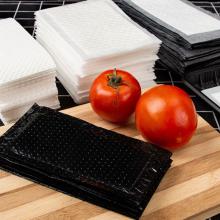
- Absorbent pads - the pad controls drip from fresh protein, seafood and produce inside the pack, so the outer surface and the label on it stay clean through the route. Absorbency and the pad's own integrity when saturated are what matter.
The two are specified against the same route, which is why they are best compared together. Product families: eco labels and fresh absorbent pads.
What to Settle in the Specification
- The temperature at which the label is applied, which is often warmer than the temperature at which it must hold. Both ends belong in the brief.
- Whether the surface is dry, damp or frosted at the moment of labelling - this single variable changes the adhesive choice more than the temperature does.
- Time at temperature. A pack held at -18 C for a week and one held for six months are not the same requirement.
- Absorbency stated against the actual load: how much drip the pack releases, over how long, rather than a headline figure.
- Where the pad sits relative to the food and to the printed surface, because that determines whether the pack looks clean when it is opened.
- Thaw handling. Whether the pack is expected to survive a thaw-and-redisplay cycle, and what it looks like afterwards.
Where Cold-Chain Packs Go Wrong
- Labelling cold and specifying warm. A label qualified at room temperature is not qualified for the line it will actually run on.
- Ignoring condensation at the transition. The move from freezer to display is where adhesive and print most often give way.
- Sizing the pad to the pack instead of to the load. An undersized pad saturates and stops managing drip well before the route is over.
- Testing the label and the pad separately. They are in contact with the same moisture; the combination is what the buyer actually receives.
FAQ
Can labels be applied to a frozen surface?
Yes, with an adhesive specified for low-temperature application and, more importantly, for the surface condition at that moment. Frost and condensation affect the bond more than the temperature alone.
Does a cold-resistant label also need to resist moisture?
In practice the two requirements travel together. The transitions in a cold chain - freezer to case, case to transport - are exactly where water appears on the surface.
How should absorbency be compared between two pads?
Against the same load and the same duration. State the drip volume and the holding time, then compare under those conditions; a capacity figure alone does not predict how the pack looks when opened.
Should the pad be placed before or after the food is packed?
It depends on which surface you need to keep clean. Agree the packing order as part of the specification rather than leaving it to the line, since the two choices produce visibly different results.