
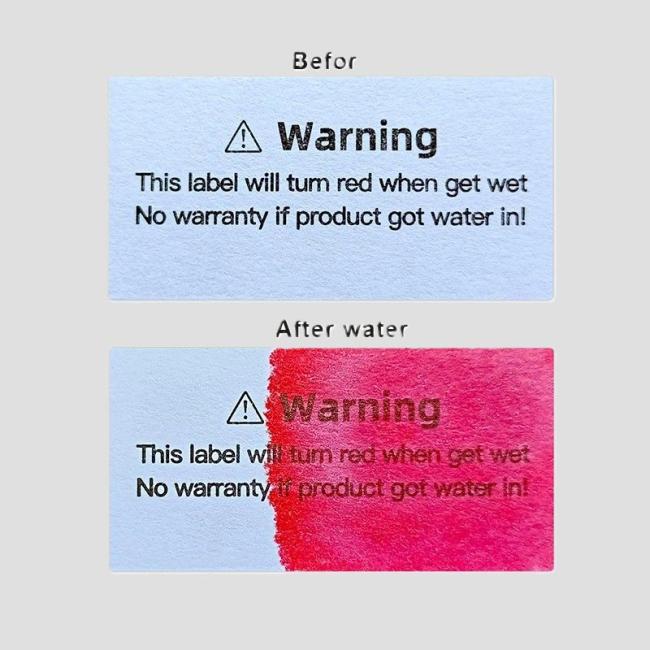
- Indication: colour change on contact with water; red and blue colour pairs as standard
- Face: coated paper or film, grade identified
- Format: rolls or sheets, die-cut to the agreed shape
- Other colour pairs: assessed per project
- Behaviour after drying: permanent or reversible, confirmed by grade
- Printing: fixed artwork, serials, barcodes or QR codes
- Adhesive and surface: matched to the pack and confirmed by trial
A water-sensitive label, also called a water-indicating label, changes colour where it gets wet. That behaviour answers a different question from "was this opened": it shows whether a pack, document or sealed unit has been exposed to water. That is the check a warranty seal on an appliance, an archive envelope or a carton with a keep-dry rule actually needs.
We supply labels that turn from their base colour to red, blue or another agreed colour on contact with water. The trigger, the colour pair and whether the change stays visible after drying are agreed for the grade, so confirm the behaviour on the actual pack before specifying it.
Page scope: This page covers water-contact indication. For a mark that shows lifting or removal, see VOID Tamper-Evident Labels or Frangible Paper Labels.
VOID Tamper-Evident Labels · Frangible Paper Labels · Anti-Counterfeit Labels
Where Water-Sensitive Labels Are Used
- Appliance and electronics warranty seals — show that a unit has been exposed to water after sealing.
- Documents and archive envelopes — an envelope that should have stayed dry.
- Logistics and warehousing — cartons, totes and outer packs with a keep-dry requirement.
- Retail and brand packaging — a visible check on a pack that should not be wiped or soaked.
- Quality-hold and inspection tags — a simple reference against a defined handling rule.
Need the opening or removal to show as well? That is a separate construction: compare VOID Tamper-Evident Labels and Frangible Paper Labels.
Key Features
A change anyone can see
The indication is visual: no reader, phone or scanner is needed. The colour change is checked at the point of use by the person handling the pack; agree what counts as a positive result before the labels are applied.
Colour and trigger agreed per grade
Red and blue are the common colour pairs; other colours are assessed per project. State where water is expected to reach the label and how much exposure counts, then confirm the response time and the colour on a sample rather than assuming one result for every grade.
Permanent or reversible, stated in advance
Some constructions keep the new colour after the label dries; others recover. Decide which behaviour your check depends on, a permanent record or a live indication, and confirm it on the real surface and drying conditions.
Printed and converted to your format
Fixed artwork, serials or QR codes can be printed, and the label supplied in rolls or sheets, die-cut to the agreed shape. The printing and the indicator are separate requirements; approve both on the finished sample.
Technical Specifications
Indicator behaviour, colour and construction are confirmed per grade. Check the following before approving a sample.
- Indication: colour change on contact with water; base colour and changed colour agreed.
- Response: time to change and behaviour after drying confirmed for the grade.
- Acceptance: water-exposure trial on the actual pack under the agreed condition.
Custom requirements are assessed against the proposed construction and a reference sample.
How to Select and Order
Fix the construction before a sample is made. Each part below says what it decides, the options available, and what we need from you.
1. Face stock — decides the colour change itself
Coated paper or film carrying a water-indicating layer, in red and blue colour pairs as standard.
What we need from you: Whether the change has to be unmistakable at a glance or as an evidence record, and what the label is applied to.
2. Adhesive
Permanent acrylic, matched to the pack.
What we need from you: The surface and whether the pack is chilled or damp.
3. Liner
Glassine liner, standard.
What we need from you: Your applicator type and the format you handle.
4. Service conditions — reversible or permanent is the whole decision
Some indicators recover as they dry; others stay changed. Which one you need depends entirely on when the check happens: on the line, at delivery, or weeks later.
What we need from you: Where water can reach the pack · when the check is performed · whether the change must remain visible after drying · how much water triggers it.
5. Printing
The indicator area must stay clear of ink, or be printed with an ink that does not block the indication.
What we need from you: Your artwork, and which area must remain unprinted.
Before the order runs
- Describe the pack, where water could reach it and who performs the check.
- Choose the colour pair and whether the change must stay visible after drying.
- Trial the label on the real pack at the real exposure, then approve artwork and format.
Send the surface, size, quantity and artwork to request samples and confirm the construction.
Related: VOID Tamper-Evident Labels · Frangible Paper Labels · Anti-Counterfeit Labels · Anti-Counterfeit Labels: How Authentication Features Work
FAQ
Does the colour return to normal when the label dries?
It depends on the construction. Some grades keep the changed colour, others recover; state which behaviour your check relies on and confirm it under your drying conditions.
Does it react to humidity or only to liquid water?
Do not assume a humidity response. Define the exposure you need to detect, a splash, immersion or condensation, and confirm the grade against that condition.
How quickly does the change appear?
Response time depends on the grade and on how much water reaches the label. Measure it in your own trial with the amount and duration that represent the risk.
Can it replace a moisture meter or a desiccant indicator?
No. It gives a visible indication that water reached the label; it is not a measurement instrument and does not report a moisture level.