
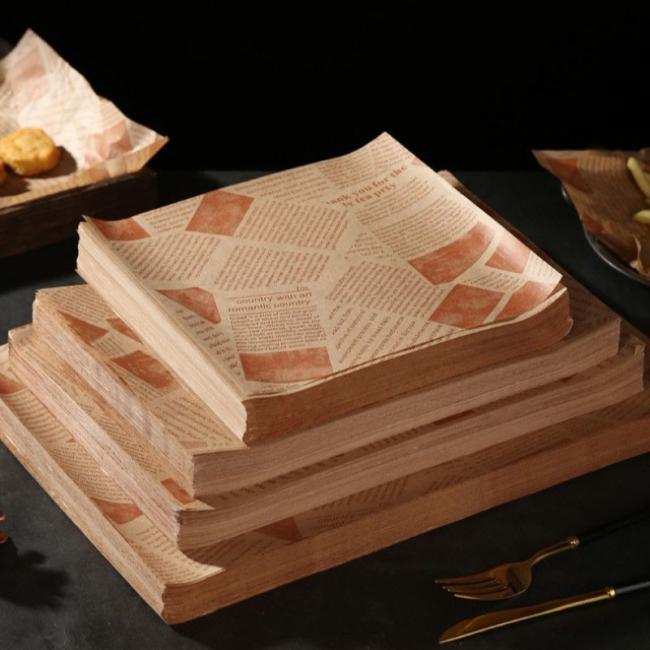
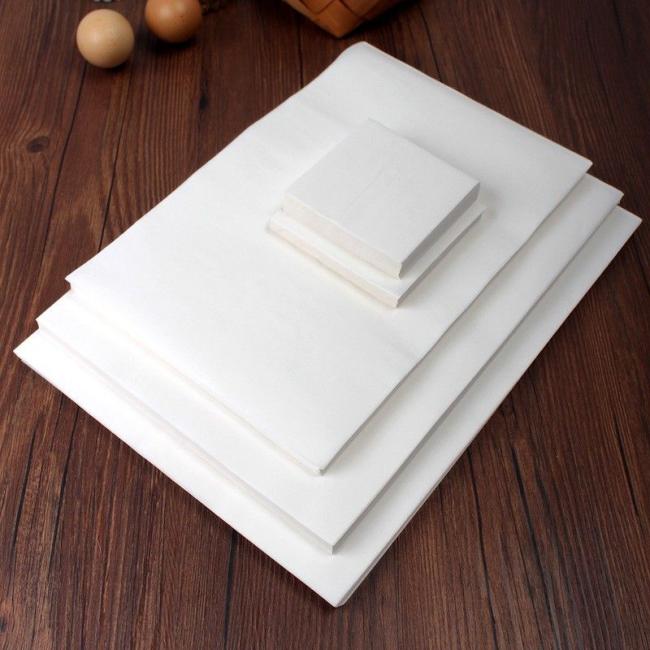
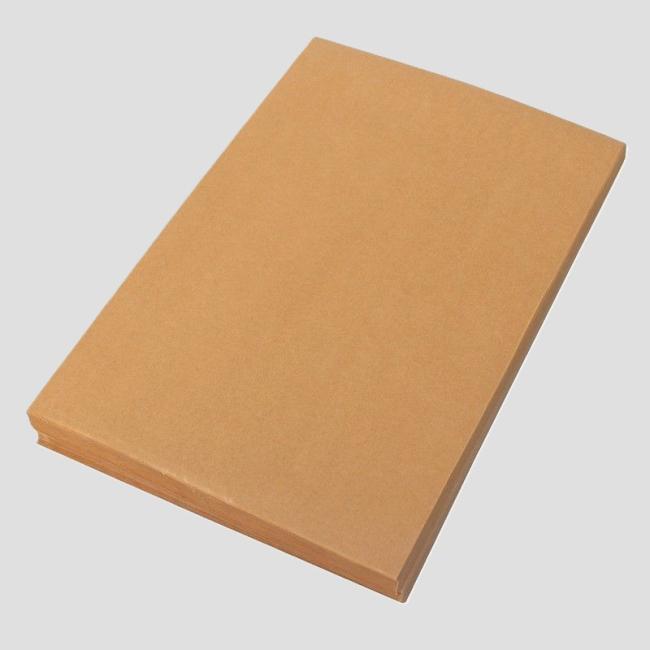
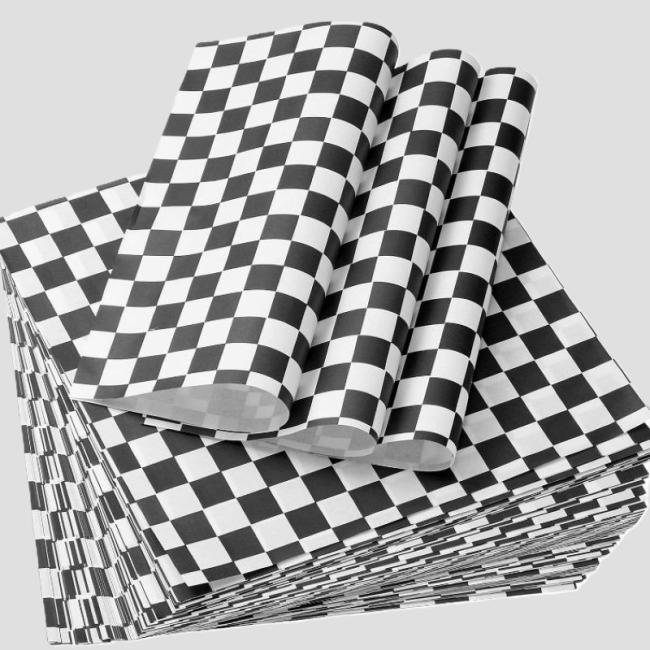
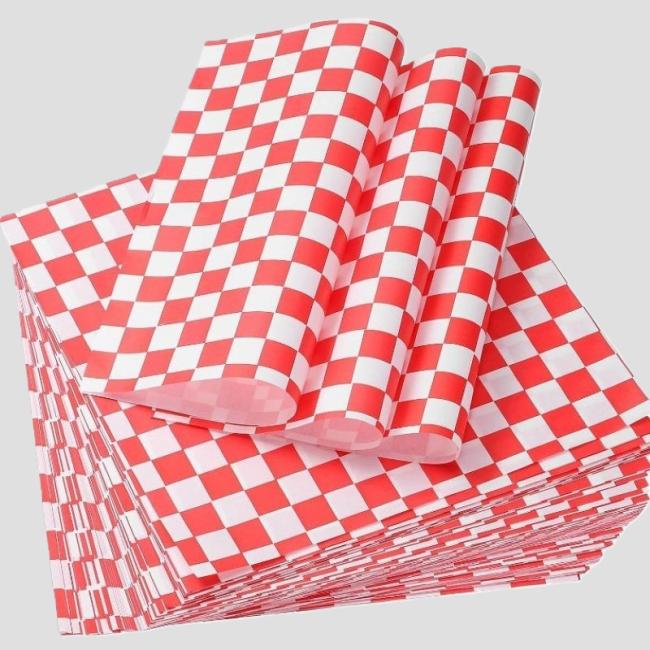
- Base paper: food-grade paper
- Basis weight: 38 / 39 / 40 / 60 gsm
- Barrier: greaseproof (no applied coating); silicone-coated; water-based coated (fluorine-free); PE-laminated
- Colours: white, natural brown, printed
- Size: 15–30 cm wide × 15–40 cm long, cut to order
- Packing: 50 / 100 / 500 sheets per pack
- Printing: food-grade ink, custom logo or design on request
- Compliance: food-contact documentation available on request
- Cut to your table or tray footprint
- Barrier selected to the food and the contact time
- Printed to your artwork in food-grade ink
- Pack size and packing configured to your service
- Food-contact documentation for your target market
A restaurant resets forty covers before service slows, and every one of those plates lands on a mat. Buy the wrong sheet and the failure is quiet: fat bleeds through onto a lacquered top, the edge lifts where a glass has been standing, the print transfers to the table, and the front-of-house team spend the turn wiping instead of seating.
Placemats leave our converting lines cut, printed and packed in the format a service actually uses, on food-grade paper between 38 and 60 gsm. Coating, laminating, cutting and printing sit on the same site, so one order covers the surface treatment, the size and the artwork together. What separates one mat from another is that treatment: untreated greaseproof paper for dry counter work, silicone where a hot plate is set down, a water-based coating for markets that restrict PFAS, and PE film where the table is wet all evening.
Where Food-Grade Greaseproof Placemat Paper Is Used
A mat earns its place three ways: it protects the surface, it holds the brand, and it decides how quickly a table can be cleared.
- Full-service restaurants — covers for à la carte and set menus, changed between sittings.
- Hotels and event venues — banquet rows and buffet stations, laid out in bulk before doors open.
- Quick-service outlets, food halls and staff canteens — trays and table tops under baskets, boards and cups.
- Bakeries and coffee bars — pastry and sandwich counters, taking butter, cream and crumbs.
- Retail and private label — pads and printed packs for home sale under your brand.
Mats are usually ordered alongside napkins, wrap and takeaway bags as one front-of-house kit, and that grouping is covered under Foodservice, Catering & Kitchen. The wider paper range is under Baking & Food Paper.
Key Features
The surface treatment decides the job
Untreated greaseproof paper resists fat on its own and suits bread, pastry and anything served dry. Silicone lets a hot plate rest on the sheet and lift away without a mark. A water-based coating gives oil hold without fluorine, which is what a market restricting PFAS in food-contact paper asks for. PE film is for the wet case — iced drinks, ice buckets, tables wiped between covers. Tell us the dish, the hold time and the table, and the treatment follows from that.
A mat is cut for the table it covers
Give us the table rather than the plate: a two-cover setting at 30×40 cm, a 25×35 cm plate mat, a tray outline or a run of bar top. Cutting to that footprint removes the two commonest complaints at the pass — a mat that catches the next tray because it overhangs, and a mat that leaves the corners of the table bare.
Print sits in front of the guest for the whole meal
A logo, a pattern, a menu line or an allergen note, laid down in food-grade ink in the colours you already run. The sheet is read by every guest at the table for as long as they are sitting there, which is more exposure than most printed items get in a restaurant. Colour count and ink coverage decide whether the run is worth setting up; send the artwork with a volume and we will judge it.
Packs built around the service pass
Sheets come 50, 100 or 500 to a pack, flat and boxed so they store behind the pass. A pack that gives one sheet at a time keeps the pace; a block that has to be peeled apart costs a second at every cover. Describe how staff take a mat and the pack is configured to match.
Technical Specifications
Most placemat briefs fall inside the following range:
- Base paper: food-grade paper, 38 / 39 / 40 / 60 gsm
- Barrier: greaseproof (no applied coating); silicone-coated; water-based coated (fluorine-free); PE-laminated
- Size: 15–30 cm wide × 15–40 cm long, cut to order
- Colour: white, natural brown, or printed to your artwork
- Packing: 50 / 100 / 500 sheets per pack
| Setting | Usual size | Basis weight | Packing |
|---|---|---|---|
| Café and bakery counter service | 25×35 to 30×40 cm | 38 / 40 gsm | 50 or 100 sheets |
| Restaurant covers — à la carte and set menus | Cut to the cover | 40 gsm | 100 or 500 sheets |
| Hotel banquet and event tables | 30×40 cm, laid in bulk | 40 gsm | 500 sheets |
| QSR tray mats and canteen tables | Cut to the tray footprint | 38 / 40 gsm | 500 sheets |
| Retail and private-label packs | Custom | 40 / 60 gsm | 50 or 100 sheets |
Width, length, treatment and print are fixed together on the order, which is usually simpler than forcing a stock size onto a table. Weight tracks the service — 38 gsm folds and stacks for counter work; 40 and 60 gsm hold flatter under hot plates and a cloth. The same papers can also be shipped in rolls and sheets to converters printing and die-cutting in house; ask for stock grade if the finishing is yours.
How to Select and Order
- Begin with the table — the dish, the hold time and whether drinks sweat on the surface point to the treatment.
- Measure the table or tray, not the plate; the cut follows that measurement.
- Match weight to service — light for folding and stacking, heavier where the surface stays damp.
- Fix the print before the pack — colour count and coverage decide the setup cost.
- Choose the pack against volume — 50 for retail and small rooms, 100 for counter service, 500 for banquets and busy chains.
- Send four details — setting, dish, destination market and volume — and the reply covers grade, cut, print and packing. Request a quote or sample.
- EU food-contact paper. PFAS restrictions have applied to food-contact paper and board since 12 August 2026 — tell us the destination market and what the mat carries, and we will confirm the grade, the grease-resistance route and the documentation you need. Fluorine-free grades are available on request; compliance documents are provided offline and we do not publish certificate numbers online.
FAQ
Is a placemat different from a baking sheet or a tray liner?
They serve different surfaces. A baking sheet goes into an oven and has to release; a mat lies on the table and has to hold oil, condensation and ink. Tray and basket liners are the middle case and are ordered with wrapping paper. For oven work see Pre-Cut Parchment Sheets, and for wrapping see Greaseproof Food Wrapping Paper.
Does the sheet contain fluorine?
By grade, not by page. Untreated greaseproof carries no applied coating; silicone and water-based coatings are formulated without fluorine; PE film is plastic and does not qualify. If your market restricts PFAS in food-contact paper, name the market and the dish and we will confirm the treatment and the paperwork — sent offline.
Can our artwork be printed on the mat?
Yes, in food-grade ink, as part of the run. Colour count, coverage and run length decide the setup, so artwork goes with a quantity and we come back on what is feasible.
Which size and weight is a sensible first order?
Start from the table: 30×40 cm and 25×35 cm cover most restaurant and café settings, while tray mats follow the tray. Weight follows use — 38 gsm for folded counter service, 40 gsm for plated tables, 60 gsm where the surface stays wet. Send one setting and one tray and the first sample pack is cut to both.
Related: Pre-Cut Parchment Sheets · Greaseproof Food Wrapping Paper · Foodservice, Catering & Kitchen
Base papers: Food-grade Silicone-coated Paper · Water-based Coating Paper