
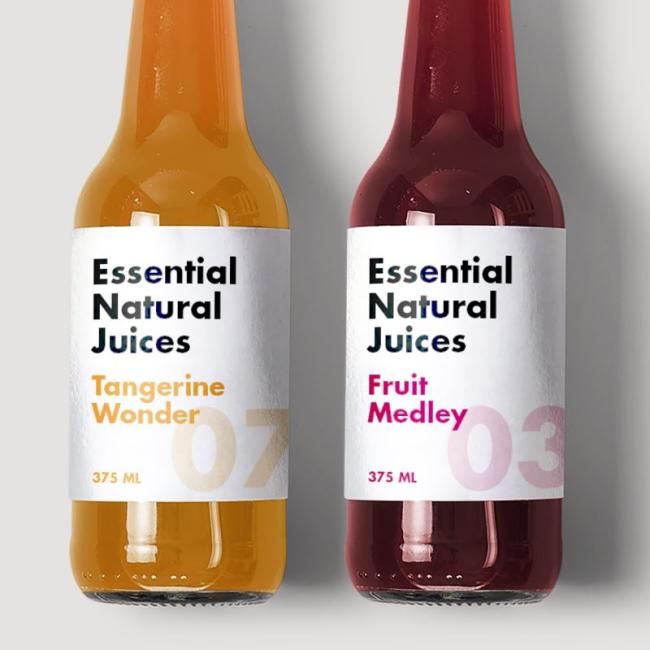
- Material types: Transparent BOPP / Bright-white BOPP / Matte BOPP / CPP
- Thickness: 30–100 μm (customised to the printing and labelling method)
- Operating temperature: -50°C to +120°C (freezer- and pasteurisation-tolerant)
- Printing: flexographic, letterpress, screen and digital (HP Indigo); corona-treated face
- Labelling methods: self-adhesive (roll stock or sheets); wet-glue option
- Key properties: water- and moisture-resistant, oil-resistant, tear-resistant, dimensionally stable
- Finish and adhesive: high transparency / high-gloss / matte; adhesive grade matched to the container
Most bottle labels are read in a wet or cold moment — a shampoo bottle in a steamy shower, a juice bottle straight from the fridge, a detergent bottle squeezed under running water. Paper labels soak up that moisture: they wrinkle, curl and cloud, and on a squeezable bottle the face cracks and lifts. In a freezer or a pasteurising bath the print and edges give way, and the pack starts to look tired on the shelf — barcode hard to scan, ingredient text hard to read.
We supply PP film labels — transparent, bright-white and matte polypropylene film in biaxially oriented (BOPP) or cast (CPP) form — for bottles and containers that meet water, chill, squeeze and heat. The film does not absorb water, so labels stay flat and clear in condensation and damp. The construction is rated from -50°C to +120°C, covering freezer storage and pasteurisation baths.
Where PP Film Labels Are Used
Clear, white and matte film labels for packs that meet water, chill, squeeze and heat:
- Personal care and household — shampoo, shower-gel and detergent bottles: the film follows squeezable containers without wrinkling and holds up to steamy bathrooms.
- Food and beverage — water, juice, dairy, sauce, beer and frozen-food packs: moisture- and cold-resistant, with transparent BOPP giving the clear, 'no-label' look that lets the contents show.
- Pharmaceuticals — durable, legible outer labels on medicine bottles and cartons, outside direct contact with the contents.
- Industrial and chemical — drum and container labels for lubricants and chemical products, where the face must resist oils and solvents.
- Retail and spirits — glossy or matte film for a premium feel on wine and craft-beer bottles, where glare and fingerprints matter.
Where the label must follow the squeeze of a detergent or personal-care bottle more closely, PE Film Labels offer the flexible alternative; for a pearlescent finish on retail cosmetics see Pearlized Film Labels. For a label face that prints like paper but resists water, oil and tearing on outdoor tools, electronics or logistics packs, that is the PP synthetic paper line — see Synthetic Paper Labels.
Key Features
A film face for the look you need
Choose transparent BOPP when the contents should carry the pack — the clear film lets the bottle show through for a clean, 'label-free' look. Choose bright-white film when the label must do the talking: the clean white base keeps brand colour and fine text vivid. Choose matte BOPP when glare and fingerprints matter — the low-reflection face reads softly under shop lights.
Stays flat and clear where labels get wet or cold
Polypropylene does not absorb water, so the face does not wrinkle, curl or cloud in condensation and damp. Rated from -50°C to +120°C, the construction covers freezer storage, chilled distribution and pasteurisation baths — print stays put, edges stay down and barcodes keep scanning.
Print detail and dense colour on film
The print face is corona-treated for ink anchorage and compatible with flexographic, letterpress, screen and digital (HP Indigo) printing. Small text, logos and QR codes hold clean edges, and printed colour stays saturated on the smooth film surface.
Dimensional stability that keeps a labelling line running
The oriented film resists expansion and contraction with temperature and humidity, so die-cut labels keep their size and print registration holds through storage and high-speed application.
Technical Specifications
- Material types: transparent BOPP / bright-white BOPP / matte BOPP / CPP
- Thickness: 30–100 μm (customised to the printing and labelling method)
- Operating temperature: -50°C to +120°C (freezer- and pasteurisation-tolerant)
- Printing: flexographic, letterpress, screen and digital (HP Indigo); corona-treated face
- Labelling methods: self-adhesive (roll stock or sheets); wet-glue option
- Key properties: water- and moisture-resistant, oil-resistant, tear-resistant, dimensionally stable
- Finish and adhesive: high transparency / high-gloss / matte; adhesive grade matched to the container
The face decides how the pack reads; thickness and format follow the line. Typical starting points:
| Use | Film face | Thickness | Labelling |
|---|---|---|---|
| Personal care and household — shampoo, shower-gel and detergent bottles | Matte BOPP, to soften glare and fingerprints | 30–60 μm | Self-adhesive roll stock |
| Food and beverage — water, juice, dairy, sauce, beer and frozen-food packs | Transparent BOPP, for the clear 'no-label' look | 40–60 μm | Self-adhesive roll stock |
| Pharmaceuticals and industrial chemical — medicine bottles and cartons, lubricant and chemical drums | Bright-white BOPP, for vivid print and dense data | 50–75 μm | Self-adhesive rolls, or sheets for short runs |
| Retail and spirits — wine and craft-beer bottles | High-gloss or matte BOPP | 50–80 μm | Self-adhesive roll stock; wet-glue on selected bottling lines |
The film is rated −50 °C to +120 °C, so condensation, freezer storage, chilled distribution and pasteurisation all sit inside the range — but tell us your conditions and container so the adhesive and thickness are matched.
How to Select and Order
- Choose the face by how the label should look — transparent BOPP keeps the product visible; bright white carries vivid brand print on food, beverage and pharma packs; matte softens glare on wine, craft-beer and personal-care bottles.
- State the environment — condensation, freezer storage, chilled distribution or pasteurisation all sit inside the -50°C to +120°C rating, but tell us your conditions and container so we match the adhesive and thickness.
- Match the format to your line — die-cut self-adhesive rolls feed automatic applicators; sheets suit manual or short runs; wet-glue suits selected bottling lines.
FAQ
- Transparent, white or matte — which film do I need? Transparent BOPP lets the product show through for water, oil and cosmetic bottles; bright white is the clean base for vivid colour print on food, drink and pharma; matte cuts glare and fingerprints on premium wine, spirit and personal-care packs.
- Will the label survive freezing or pasteurising? Within the rated range, yes — the film is rated from -50°C to +120°C, covering freezer storage and pasteurisation baths.
- What printing methods are supported? The corona-treated face takes flexographic, letterpress, screen and digital (HP Indigo) printing, so most label converters and in-house lines can print it without a special coating step.
- Is this the same as synthetic paper labels? No. PP film here is chosen for clear, white and matte bottle and container labelling in wet, cold and squeezable conditions. Synthetic paper has a paper-like printable face with plastic durability for outdoor tools, electronics and logistics — it is a separate product family.
- Can I test it under my own conditions first? Yes — request samples, run them through your printing, chill or squeeze test, then confirm the specification before you order.
Bofeng New Materials supplies clear, white and matte PP film labels to brand owners, label converters and packaging buyers as part of its Eco Labels range. Tell us your container, environment and print method and we will confirm the film grade, adhesive and format for you.
Get a quote or request samples: jason.zhan@bofmat.com
Related: Film Labels · PE Film Labels · Pearlized Film Labels
Related reading: Film Label Facestocks Compared: PET, PP, PE and PVC · Waterproof Labels for Wet and Wash-Down Environments