
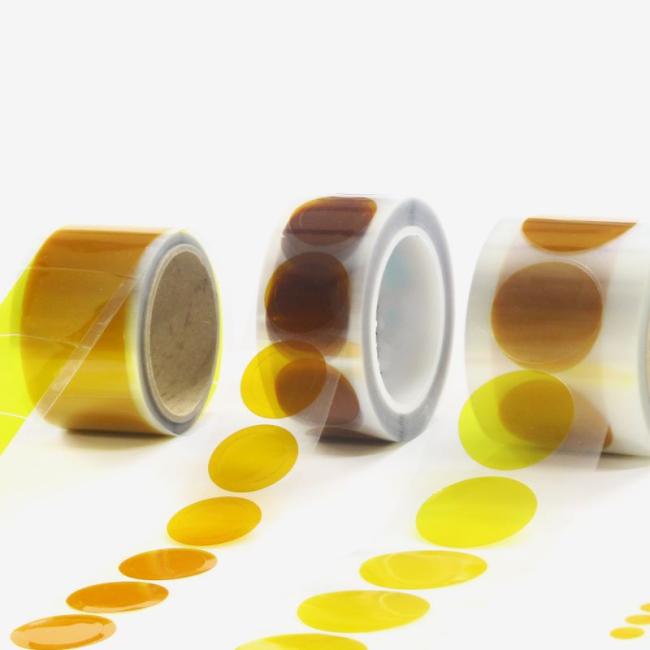
- Material: Amber polyimide film / black polyimide film
- Common thicknesses: 25 μm / 50 μm / 75 μm / 125 μm
- Temperature range: -269°C to +500°C; short-term up to 800°C
- Dielectric strength: 200 KV/mm
- Flame retardancy: Flame-retardant film that does not support combustion
- Key properties: Extreme-temperature resistance, flame retardancy, electrical insulation, chemical resistance, radiation resistance, dimensional stability
- Size / die-cut / adhesive grade: customised to the application
A printed circuit board or electronic module usually carries its identification label before it goes through reflow or wave soldering — and that label still has to be readable when the board ships and, years later, when it is serviced. Ordinary label face-stock chars, curls or lifts at soldering heat, and in hotter service — engine compartments, furnace-adjacent plant, battery modules under load — it fails even faster. When the marking goes, the trace goes with it: no batch number, no warranty answer, no repair history.
We supply polyimide (PI) film labels for that job. Polyimide holds its shape and its electrical and chemical properties from -269°C to +500°C, with short-term peaks to 800°C, so printed serials, date codes and barcodes survive soldering heat and stay legible through years of high-temperature service. Amber and black films in thicknesses from 25 to 125 μm cover general electronic components through to demanding industrial equipment.
Where PI Film Labels Are Used
Identification that must stay readable through extreme heat and harsh service:
- Electronics manufacturing — PCB and component identification carried through reflow and wave soldering; semiconductor and module traceability.
- Aerospace — permanent identification on high-temperature components in engine compartments, avionics and assemblies.
- Defence electronics — high-temperature identification on modules and systems in military equipment, part of the routine industrial supply chain.
- Industrial manufacturing — labels on welding fixtures, furnace-adjacent equipment and high-temperature process piping.
- New energy vehicles — high-temperature labelling on battery modules and motor systems.
For a lower temperature band, see PET Film Labels; where a moisture- and chemical-resistant synthetic film fits the job, Synthetic Paper Labels are an alternative — both linked below.
Key Features
Identification that survives soldering and extreme heat
The film is rated from -269°C to +500°C, with short-term peaks to 800°C, and does not melt, char, shrink or delaminate at soldering heat or in hot industrial service. Markings stay intact and scannable when the part leaves the line and when it is serviced later — no re-labelling, no lost traceability.
Electrical insulation on powered and high-voltage assemblies
The film's dielectric strength is 200KV/mm, so a label on a high-voltage or high-frequency circuit or a battery cell does not compromise insulation. Identification can be applied to powered assemblies without adding a separate insulating layer or bridging risk.
Resists the chemicals, radiation and cleaning of its working environment
Polyimide resists attack by most organic solvents, acids and alkalis and withstands radiation, so markings hold through cleaning baths, process chemicals and specialised high-radiation service. A grade with enhanced chemical resistance is available for demanding environments.
Dimensionally stable, with print that stays legible
The film's very low thermal-expansion coefficient keeps die-cut labels and printed codes in place through temperature swings, and markings are printed with specialised inks that remain fixed and legible under high temperature and pressure.
Flame-retardant, for fire-safety-critical equipment
The film is flame-retardant and does not support combustion, which suits labels on powered equipment, battery systems and other fire-safety-critical assets; compliance documentation is available offline on request.
Technical Specifications
- Material: amber polyimide film / black polyimide film
- Common thicknesses: 25 μm / 50 μm / 75 μm / 125 μm
- Temperature range: -269°C to +500°C; short-term up to 800°C
- Dielectric strength: 200 KV/mm
- Flame retardancy: flame-retardant film that does not support combustion
- Key properties: extreme-temperature resistance, flame retardancy, electrical insulation, chemical resistance, radiation resistance, dimensional stability
- Size / die-cut / adhesive grade: customised to the application
Tell us the peak temperature, the environment and the substrate your label must survive; we will confirm the film, thickness and die-cut.
The film and thickness follow the process heat. Typical starting points (rated −269 °C to +500 °C, short-term peaks to 800 °C):
| Application | Film | Thickness | Typical hot service |
|---|---|---|---|
| Electronics manufacturing — PCB and component identification carried through reflow and wave soldering; semiconductor and module traceability | Amber polyimide, the general-purpose grade | 25 or 50 μm, for space-constrained components | Reflow and wave-soldering peaks |
| Aerospace and defence electronics — engine compartments, avionics and high-temperature assemblies | Amber or black polyimide, black for a uniform appearance | 50–75 μm | Engine compartments and avionics |
| Industrial manufacturing — welding fixtures, furnace-adjacent equipment and high-temperature process piping | Black polyimide | 75–125 μm, where durability matters most | Furnace-adjacent service |
| New energy vehicles — battery modules and motor systems | Amber polyimide | 50–75 μm | Battery and motor hot zones |
Dielectric strength is 200 KV/mm and the film is flame-retardant, so it also serves as electrical insulation on powered and high-voltage assemblies. Send your actual peak and thermal profile, the substrate, label size and annual volume and we will confirm the specification.
How to Select and Order
- Match the rating to your process — -269°C to +500°C, with short-term peaks to 800°C, covers reflow and wave soldering and most hot industrial service; send your actual peak and thermal profile and we will confirm the fit.
- Choose the film and thickness by the job — amber film is the general-purpose grade for most electronic components; black film suits a uniform appearance in premium equipment; the 25 μm grade fits space-constrained components; 50–125 μm films add durability.
- Send the environment (solvents, acids, radiation), the substrate, label size and annual volume — we will recommend film, thickness, adhesive grade and die-cut, and confirm the specification before you order.
MOQ, lead time and freight depend on size, thickness and quantity — send your spec and volume and we will quote.
FAQ
- Will it survive reflow or wave soldering? Yes, within the rated range — -269°C to +500°C, with short-term peaks to 800°C. Send your oven profile and we will confirm the grade.
- What is the difference between amber and black film? They share the same temperature, insulation and chemical properties; amber is the standard grade for most electronic-component marking, and black for a uniform dark appearance.
- How thin can the labels be? The thinnest grade is 25 μm, for space-constrained components; 50, 75 and 125 μm films add durability.
- Is it flame-retardant? Is it certified? The film is flame-retardant and does not support combustion. Certification and compliance documentation is provided offline on request; we do not publish certificate numbers online.
- Can I test it under my own heat profile before ordering? Yes — request samples, run them through your soldering or heat cycle, then confirm the specification.
Bofeng New Materials supplies polyimide (PI) film labels to electronics manufacturers, PCB assemblers, and aerospace, defence and new-energy suppliers as part of its Eco Labels range. Send us the temperature and environment your label must survive and we will confirm film, thickness and adhesive grade.
Get a quote or request samples: jason.zhan@bofmat.com
Related: Film Labels · PET Film Labels · Synthetic Paper Labels
Related reading: Heat & Chemical Resistant Labels: Choosing by Temperature and Exposure · PI Film Labels for High-Temperature and Electronics Use · Anti-Static Labels for Electronics Packaging