
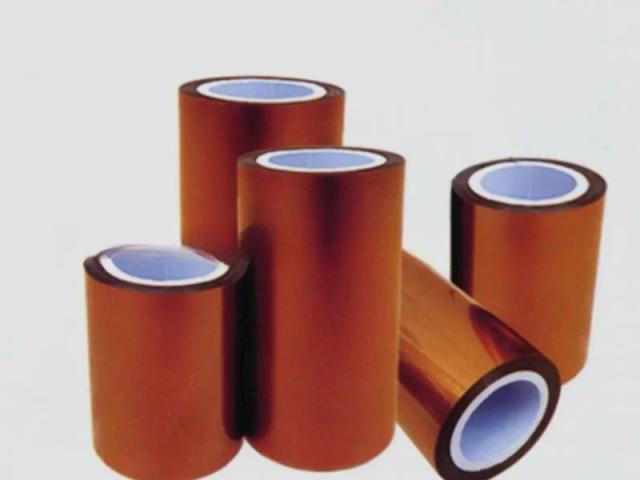
Polyimide film labels cost several times what a high-temperature PET does, and in many processes that extra money buys nothing. The question is not whether PI is good — it is whether both of these are true at once: the temperature is continuous, and the label also has to insulate or stay dimensionally fixed. This guide sets out what PI actually buys, where it earns its cost, and where a cheaper film does the same job.
1. What PI buys you
Three properties, and they come as a package.
- A high continuous service temperature. PI holds where polyesters soften — the working range, not a seconds-long excursion.
- Dimensional stability under heat. The film barely shrinks or grows, so a printed dimension stays a printed dimension after a thermal cycle.
- Electrical insulation. High dielectric strength and volume resistivity, which is what makes it useful inside equipment rather than merely near heat.
Two of the three are also available from other materials. High-temperature PET covers the thermal side for short exposures, and laminated constructions can add insulation. Only the combination in one film is hard to replace.
2. Where the cost is earned
Run the application against two questions.
- Is the temperature continuous? Hours or years at temperature is a different requirement from a few seconds in a reflow oven. If it is seconds, a high-temperature PET grade usually survives, and costs far less.
- Does the label have to do an electrical job? If it only identifies, a heat-resistant film with an appropriate adhesive is enough. If it must insulate a conductor or hold a printed dimension across thermal cycling, PI starts to pay.
Both answers have to be yes. One yes on its own rarely justifies the price difference, and the second question is the one buyers most often skip.
3. Choosing by process
| Process | Continuous temperature | Insulation needed | PI required | Alternative |
|---|---|---|---|---|
| SMT reflow | no — seconds | no | usually not | high-temperature PET |
| Wave soldering | no — brief | no | usually not | high-temperature PET, with a matched adhesive |
| Battery pack interior | yes, warm and constant | often yes | yes, where it insulates | none equivalent |
| Wire and cable marking | yes | sometimes | yes, for high-temperature cable | heat-shrink marking where the process allows |
| Motor nameplate | yes | yes | yes | laminated nameplate construction |
The table describes temperature by behaviour rather than by a number, because the figure depends on the grade and on the adhesive. Ask for the continuous rating with a duration attached — the same discipline as for any high-temperature label. Where the electrical requirement leads and the temperature is moderate, start from the functional labels group instead.
4. What to watch in application
- PI is only half the construction. A silicone or acrylic adhesive rated below the film's limit becomes the failure point. Specify the adhesive's continuous temperature separately.
- It is stiff and unforgiving. PI does not wrap tight radii, and a crease in the film does not flatten out. Plan flat faces and generous bend radii.
- Cost per label is driven by area. Because PI is priced by area, shrinking the label and laying more per web is often the largest saving available — larger than switching material.
- It is not automatically ESD-safe. Insulating and static-dissipative are opposite requirements. Electronics work that also needs static control is a separate specification; see anti-static labels.
FAQ
Can I use PI film for a reflow process?
Yes, and it is often specified there, but it is usually more material than the process needs. If the exposure is seconds and no insulation is required, a high-temperature PET grade is normally sufficient.
What adhesive goes with PI film?
Silicone adhesives are the usual choice for the highest continuous temperatures; acrylics are common where the temperature is lower and cost matters more. Match the adhesive to the same temperature the film is rated for.
Is PI film available in different thicknesses?
Yes. Thickness affects stiffness and dielectric strength, so it is a specification decision rather than a stock choice. Confirm it against the insulation requirement.
Why is PI more expensive than other films?
It is a higher-cost polymer to produce, and it is supplied in smaller volumes than PET or PP. The price is a material fact rather than a markup, which is why the decision is about need rather than about negotiating.
Browse the range
Start from PI film labels, or compare against PET film labels if the temperature is a short excursion rather than a continuous condition. Send the continuous temperature, the duration and whether the label must insulate, and a construction can be matched before samples are issued.