
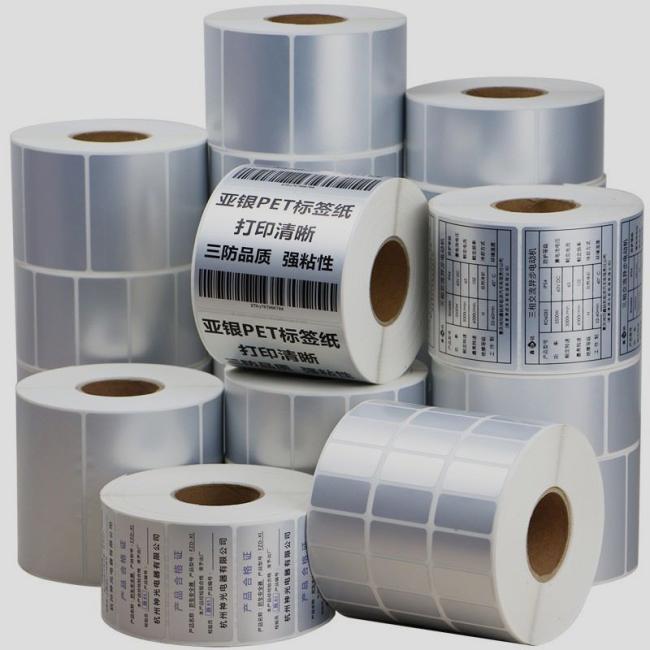
- Base material: Polyester (PET) film
- Film types: Glossy white, transparent, matte silver, glossy silver
- Thickness options: 25, 50, 75, 100 μm
- Printing methods: Thermal transfer (preferred); UV inkjet printing
- Temperature resistance: -40°C to +150°C (short-term up to 180°C)
- Adhesive: Permanent, high-strength acrylic
- Size / die-cut / roll or sheet format: Customised to the application
Some labels are asked to live as long as the product they name — a circuit board label that stays readable through years of heat and handling, an appliance nameplate that does not scuff, a chemical container tag that shrugs off solvent. Paper labels struggle in those places: they tear, smear, fade and lift, and on low-surface-energy plastics such as HDPE and PP an ordinary adhesive simply does not hold. When the label fails before the product does, serials, batches and barcodes lose their trail — and servicing, warranty and traceability lose their answer.
We supply PET film labels — a thin, strong polyester film engineered to keep printed identification legible over a long service life. The construction is rated from -40°C to +150°C with short peaks to 180°C, resists UV, humidity and temperature swings without yellowing, and withstands oils, solvents, cleaning agents and weak acids and alkalis. The coated face is matched to thermal-transfer printing for durable, scratch-resistant text and barcodes, a high-strength acrylic adhesive holds on difficult surfaces including HDPE and PP plastics, metal and glass, and glossy-white, transparent, matte-silver and glossy-silver faces cover industrial and premium-retail looks.
Where PET Film Labels Are Used
PET film labels are used where an identification label must outlast hard use and a long service life:
- Electronics and electrical — circuit board labels, appliance nameplates, cable identification and asset tracking tags.
- Industrial manufacturing — machinery identification, tool labels, chemical container tags and pipeline marking.
- Automotive and transportation — engine-bay labels, vehicle VIN tags and component traceability labels.
- Outdoor and asset management — outdoor equipment nameplates, power facility and telecom-room identifiers, and asset management.
- Premium retail — electronics and appliance labels, cosmetic instruction labels and anti-counterfeit labels for alcoholic beverages.
For a sharply curved container that needs a softer film, PVC film labels wrap those surfaces; the full range is listed under Plastic Film Labels and in the related products below.
Key Features
Thin, strong film that wears well
The polyester substrate is chosen for tensile strength, tear resistance and abrasion resistance in thicknesses from 25 to 100 μm. The label stays intact through repeated handling, wiping and contact, so a thin label does the work of a heavier one.
Heat-rated up to +150°C
The film is rated for continuous service from -40°C to +150°C, with short-term peaks to 180°C. Identification survives warm equipment, hot processes and cold environments without curling, shrinking or turning brittle, so the label keeps its shape and its legibility wherever the product is used.
Resists oils, solvents and weak acids
The film withstands most oils, solvents, cleaning agents and weak acids and alkalis found around chemical plants and laboratories. Labels on chemical containers and pipelines keep their print and their bond when paper and ordinary film would smudge or lift.
Crisp, scratch-resistant printing
A special surface coating is matched to thermal-transfer printing — the preferred method — for text, serials and barcodes that stay sharp and scannable under handling; UV inkjet printing is also supported.
A face and an adhesive for the surface
Glossy-white PET gives rich, saturated colour for high-end product labels, transparent PET gives an 'invisible' effect on glass and acrylic, and matte or glossy silver gives a metallic, high-tech look.
Technical Specifications
- Base material: polyester (PET) film
- Film types: glossy white, transparent, matte silver, glossy silver
- Thickness options: 25, 50, 75, 100 μm
- Printing methods: thermal transfer (preferred); UV inkjet printing
- Temperature resistance: -40°C to +150°C (short-term up to 180°C)
- Adhesive: permanent, high-strength acrylic
- Size / die-cut / roll or sheet format: customised to the application
The film type decides how the label reads; thickness follows the handling. Typical starting points:
| Application | Film type | Thickness | Printing |
|---|---|---|---|
| Electronics and electrical — circuit-board labels, appliance nameplates, cable identification and asset tags | Glossy white PET | 25–50 μm | Thermal transfer |
| Industrial and outdoor assets — machinery identification, tool labels, chemical-container tags, pipeline marking, power and telecom identifiers | Matte silver PET | 50–75 μm | Thermal transfer |
| Automotive and transportation — engine-bay labels, VIN tags and component traceability | Glossy silver PET | 50–75 μm | Thermal transfer |
| Premium retail — electronics and appliance labels, cosmetic instruction labels, anti-counterfeit labels for spirits | Transparent PET, for an 'invisible' effect on glass and acrylic | 25–50 μm | UV inkjet |
The film is rated −40 °C to +150 °C, with short-term peaks to 180 °C, and the high-strength acrylic adhesive suits HDPE/PP plastics, metal and glass. Tell us the exact substrate and service and we will confirm the pairing.
How to Select and Order
- Choose the film type by how the label must look and read — glossy-white PET for rich colour reproduction on high-end product labels; transparent PET for an 'invisible' effect on glass, acrylic and other transparent materials; matte or glossy silver for a metallic, high-tech finish.
- Match thickness and adhesive to the surface and the handling — thickness options run from 25 to 100 μm, and the high-strength acrylic adhesive suits HDPE/PP plastics, metal and glass; tell us the exact substrate and service and we will confirm the pairing.
- Send your surface material, environment, printing method and expected volume, and we will confirm the film type, thickness and finish before you order.
MOQ, lead time and freight depend on film type, size and quantity — send your spec and volume and we will quote.
FAQ
- To what temperature can PET labels be used? The film is rated for continuous service from -40°C to +150°C, with short-term peaks to 180°C. For continuous service above +150°C — some high-heat electronics — a polyimide (PI) film label is the type used; send us your actual temperature and we will confirm the fit.
- Will it stick to HDPE and PP plastic? Yes — the high-strength acrylic adhesive is designed for low-surface-energy plastics as well as metal and glass. Send the exact surface finish and we will confirm the grade before ordering, and you can verify with a sample.
- How is the label printed? Thermal-transfer printing is preferred — the coated face produces durable, scratch-resistant text and barcodes; UV inkjet printing is also supported.
- Can it be used outdoors? The film resists UV, humidity and temperature swings without yellowing, and is used on outdoor equipment nameplates and asset tags. Where outdoor weather is the single deciding requirement, synthetic paper labels are also worth comparing — tell us your use and we will recommend.
Bofeng New Materials supplies PET film labels to electronics and electrical brands, industrial makers, automotive suppliers and premium-retail packers as part of its Eco Labels range. Send your application, surface and printing method, and we will confirm the film type, thickness and finish before you order.
Get a quote or request samples: jason.zhan@bofmat.com
Related: Plastic Film Labels · Synthetic Paper Labels · PVC Film Labels
Related reading: Heat & Chemical Resistant Labels: Choosing by Temperature and Exposure · Film Label Facestocks Compared: PET, PP, PE and PVC · PI Film Labels for High-Temperature and Electronics Use