
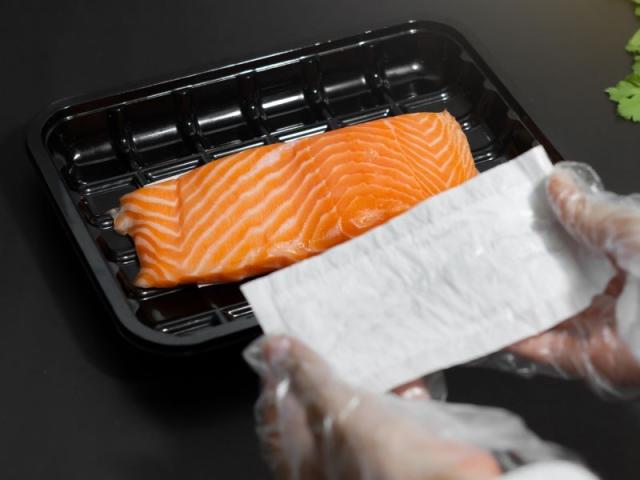
An absorbent pad costs little in a fresh pack, yet on an export order it is a cheap cause of failure at destination. A weeping tray or a wet carton base becomes claims and poor shelf pictures across a whole container. So treat the pad as a chain variable, not a last-minute accessory. This guide covers where it sits in the packing chain, shared SKUs, compliance documents, sample checks and supply questions.
1. Place the pad in your chain before you price it
A fresh pack passes through stages: the packing room, pallet stacking, the chilled container in transit, then distribution and retail display. The pad’s job differs at each stage — no weep under stacking, a dry tray base on display, and food-contact compliance for the market you ship into. Define your pain-point stage before comparing prices. If it is the moisture your goods create, the food absorbent pads overview explains it; if it is transport behaviour such as temperature and vibration, our export cold-chain guide covers the pad. This page stays with the buying process.
2. One SKU across categories, or keep them separate
Fewer SKUs means less stock, fewer spec sheets and one sample protocol. A shared SKU works when three conditions hold at once: similar moisture loads (light poultry purge is closer to produce condensation than to heavy red-meat purge), similar pack format (tray size, stacking, packing method), and construction that meets the food-contact basis of every market the SKU ships into. Keep SKUs separate when loads genuinely differ, or when a customer or market requires a specific option such as a bio-based construction. If unclear, spec toward the heavier load and confirm each pack with its own test. Rolls are the easiest point to standardise, and a bio-based version is a practical second SKU — see fresh food absorbent rolls and biodegradable fresh absorbent pads.
3. Compliance documents: collect them with the first sample
Whether a pad may enter a market is set by that market’s food-contact rules. For each layer that can touch food, ask the supplier for a food-contact compliance statement or declaration, a description of the materials, and any supporting test summary. If the pack carries a biodegradable or compostable claim, ask for the certification naming the standard and conditions. Collect this set with the first sample, not after the purchase order, and ask the supplier to flag raw-material or construction changes — a silent change can invalidate a compliance file. Food-contact safe and biodegradable are separate claims with separate documents; ask for each.
4. Samples and inspection: verify the run, not the brochure
Absorbency figures on a data sheet are a starting point, not a spec. Fit the pad into your tray, add the liquid your product gives, stack the trays, hold them at your storage temperature for about the journey time, then check for weep, pooling and pad condition. State absorbency as a range confirmed by that purge test. Then check the pad itself: uniform thickness and grammage, clean cut edges without fibre shedding, sealed film edges, no odour. Inspect the first production run, spot-check each lot for weight, size and lay-flat, and keep one reference sample per order.
5. Purchase checklist
| What to check | Why it matters | Who drives it |
|---|---|---|
| Food-contact declarations and materials for the destination market | clears compliance before shipment | Sourcing |
| Purge test on your pack at your storage temperature | confirms capacity and no-weep in real use | QC |
| Dimensional check against the tray inner base | avoids overhang and pooling | QC |
| Carton and unit packing | survives stacking and container handling | QC and freight |
| MOQ, lead time, buffer stock, incoterm | supply plan fits your reorder cycle | Sourcing |
| Reference sample kept per lot | keeps claims and documents traceable | QC |
6. Supply continuity: three questions to ask
Put these to the supplier and keep the answers in writing.
- Real lead time? Ask in production weeks against your order cycle, with a buffer for delays.
- Stock and a second source? Single-sourcing a tray liner is fragile; confirm capacity and keep a qualified alternative.
- Will they flag changes? Raw-material or construction changes should come with updated documents before the next batch ships.
Review the answers yearly, or when the pack changes. To discuss an export programme, contact us.
7. FAQ
We are a trading company — is saying “give us a pad” enough?
Not really. Give the supplier the pack facts: tray size, contents, storage temperature, voyage length, packing method and destination market. Without these a quote stays generic and the purge test means little.
Will the pads be crushed in a sea container?
The pad is a thin laminate, so the tray stack carries the load. The real question is whether it weeps under sustained stacking and temperature swings. Test with your own stacking height and journey time.
How many SKUs should we carry?
Start with one per moisture family you pack — a heavier meat-grade spec and a lighter produce spec — plus a bio option if buyers ask. Merge two SKUs only after the shared construction passes the purge test for each pack.
How do we get a small sample first?
Ask for a trial sized to a few trays and send the tray dimensions with a description of the purge. Evaluate at your site, and request the food-contact documents with the sample.
8. Start with the overview and the checklist
Start with fresh absorbent pads for the family, the category overview for moisture, and the export cold-chain guide for transport. Read the material guide for construction; add fresh food absorbent rolls or the biodegradable fresh absorbent pads when a buyer requests them, then bring this checklist to contact us to set up a trial.