
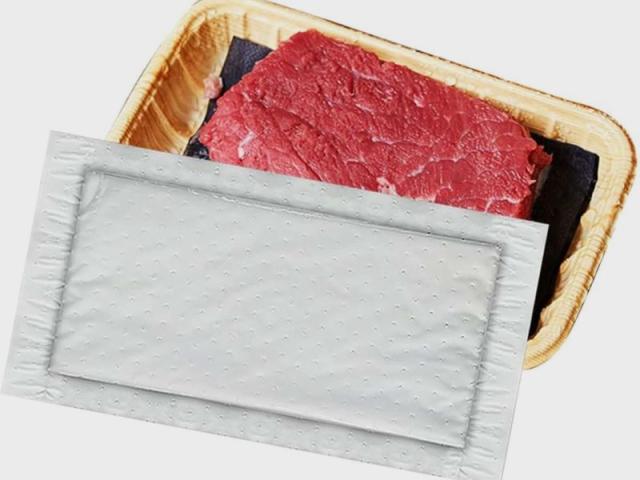
Choosing a fresh absorbent pad is not about finding a single “best material” — it is about matching the pad’s construction to the liquid you are managing, the conditions it travels in, and how the pack is handled. The construction that works under a red-meat tray on a long export chain is different from what a punnet of strawberries needs. This guide explains the layers that make up a fresh absorbent pad, the material families you will hear quoted (SAP, paper-based, bio-based), and what to verify before you order.
1. The three jobs every fresh absorbent pad does
- Move liquid away. Purge from meat and seafood, and condensation from chilled produce, must leave the product surface quickly.
- Hold it. Liquid should be locked inside the pad, not sitting in the tray or seeping back onto the product.
- Protect the pack. The tray base stays dry, so the pack looks right from factory to shelf.
A pad that absorbs quickly but weeps under stacking pressure fails the second job. This is the most common reason a pad is called “leaky” even when its absorbency looks high.
2. How a pad is built: the material layers
An absorbent pad is a laminate, and most “material” questions are really questions about one of these three layers:
- Top web (touches the food). A perforated film — commonly PE or a bio-based film — or a non-woven tissue. It controls how fast liquid enters and how the pad feels against the product.
- Absorbent core (does the work). Superabsorbent polymer (SAP) granules blended with tissue or fluff pulp, or a denser tissue on its own. SAP gives high capacity and gel-lock; the tissue gives wicking speed and bulk.
- Barrier back (the bottom). A solid film (PE/PEVA or bio-based) that stops purge from soaking the tray base or reaching the shelf. It matters most when trays are stacked in export.
So “non-woven pad” and “SAP pad” usually describe different top webs or cores — most SAP pads still need a film or non-woven layer to hold the granules. Compare pads by their construction, not by a single material name.
3. Choosing by job: what the liquid and the trip look like
| Application | Main liquid to manage | What to prioritize | Construction to lean toward |
|---|---|---|---|
| Red meat & case-ready (beef, lamb, pork) | meat purge, protein-rich | capacity + no-weep under stacking | SAP core + barrier back |
| Poultry & smaller cuts | lighter purge | speed + lock | SAP or SAP/tissue |
| Seafood & shellfish | chill melt-water, brine | capacity at chill + lock | SAP core + food-contact film top |
| Fruit & soft produce | condensation | gentle, breathable, lower absorbency | tissue/non-woven-based, lighter |
| Long cold chain / export | purge + vibration + stacking | no-weep + burst strength | tight core encapsulation + barrier back |
Absorbency targets are set by purge tests on your actual pack — a heavier pad is not automatically a better fit.
4. The three material families you will be quoted
- SAP-based. Highest capacity per gram; it absorbs and gel-locks. Uptake of salted meat purge is lower than uptake of clean water, so spec from purge testing, not from a brochure number. Food-contact-graded SAP and tissue are required.
- Paper / tissue-based (no SAP). Lower cost and, in some certified constructions, compostable; it suits light, low-purge jobs, and its capacity is limited.
- Bio-based (film + fibre). Plant-starch or bio-polyester films over a cellulose or fibre core. The renewable story is real, but “biodegradable” or “compostable” only holds under specific conditions and with certification — verify, don’t assume. See biodegradable fresh absorbent pads.
If a pad is marketed as antimicrobial, that is a functional claim: ask the supplier to show the method and result. It is not an inherent property of a food-absorbent material.
5. What to verify before you order
- The real liquid and temperature of your pack — chill vs ambient; meat purge vs produce condensation.
- Absorbency and no-weep under stacking pressure — judge by a purge or simulation test, not by quoted grams.
- Food-contact compliance of every layer for your market (basis such as EU (EC) 1935/2004 with (EU) 10/2011, or US FDA 21 CFR) — request the declarations.
- Dimensions that match the tray’s inner base, and format: sheets for manual packing, rolls for automatic lines.
- Environmental claims in writing, with the certification that supports them.
6. FAQ
What is the difference between an SAP pad and a non-woven pad?
SAP describes the absorbent core’s polymer granules; “non-woven” usually describes the top web. They answer different questions — capacity versus surface. A good specification says what the top, core and back are, not just one name.
Why does a pad sometimes leak even though it is absorbent?
Usually weep under pressure: liquid is not locked fast enough, or the core is overloaded, and stacking pushes it back out. Test under the pressure and duration your chain actually applies.
Does “biodegradable” mean the pad is food-contact safe or compostable?
Not automatically. Food-contact safety and composability are separate properties, each with its own basis or certification. Ask for each claim separately.
Which absorbency do I need for a beef tray versus berries?
Set it from purge tests on your own product and pack. Meat purge is heavier and protein-rich; produce gives condensation. Pick capacity for meat and gentleness for berries, then confirm with a sample.
7. Browse the family
Fresh absorbent pads is our overview of the family; see fruit absorbent pads and meat absorbent pads for specific lines, and ask about fresh food absorbent rolls if you pack on an automatic line.