
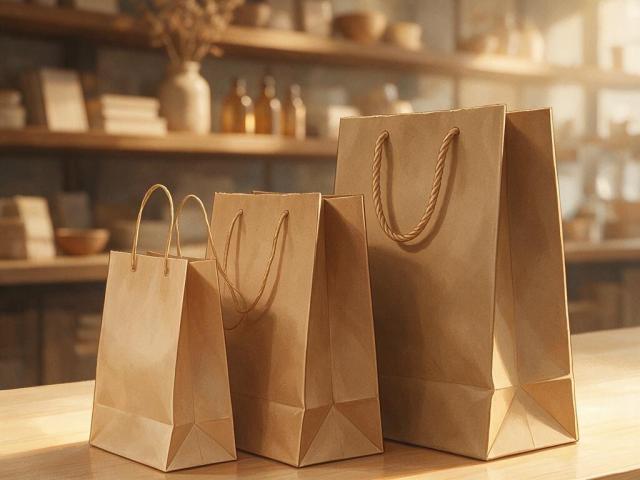
Buying a kraft paper bag by "weight" alone misses the point. What decides whether a bag survives is how you load it: the grammage of the paper, the bottom type and how the load is carried. A thicker sheet on a flat bottom can still rip at the fold when it is picked up full; a lighter sheet on a block bottom can carry more than intuition suggests. This guide turns the load question into three mechanical choices so you can spec a bag that matches how your staff and customers actually handle it.
What carries a paper bag
A paper bag takes load through three worked parts, not the paper's name:
- Grammage: the weight of the kraft sheet, which sets bulk strength and how the bag holds shape.
- Bottom type: square/block bottom carries more than flat bottom because the folds are built to take upright load; flat bottom suits lighter or part-filled use.
- Closure and handle: how the load is lifted (top seal, twisted top, or a handle) shifts stress to a different part of the bag.
How to check grammage and structure
Typical ranges (always confirm with a batch test):
- Outer bag kraft: 60–120 gsm is common for food retail, heavier for high-load or large bags.
- Bottom: square/block carries more than flat bottom at equal grammage; make structural choice, not just a weight.
- Full vs part fill: a bag that is right for a full load can deform when only partly filled and lifted.
Choosing by load
| Load | Grammage | Bottom type | Kraft (natural/white) | Lift handling |
|---|---|---|---|---|
| Light, ≤1 kg (single pastries, loose goods) | 60–80 gsm | Flat or block | Either | Twist top or flat |
| Medium, 1–3 kg (bread, veg, bakery boxes) | 80–100 gsm | Block recommended | Natural kraft or white | Top seal / block top |
| Heavy, 3 kg+ (flour, retail bulk) | 100–120 gsm | Block bottom | Natural kraft, heavier | Handle or gusset |
Match the row to your realistic load. If a line packs a range of weights, spec the bag to the heaviest routine fill and confirm it by lifting a full sample.
Closure and gusset are part of the load path
A bag is only as strong as how it is opened and closed. A twist top concentrates stress at the neck and suits light, dry goods picked up by the top; a self-seal or block top spreads the load across the mouth and is the better call as grammage and weight climb. The side gusset does different work: it lets the bag expand to the volume of the goods and gives it a stable base for stacking while the load is carried from the bottom.
So the full spec pairs grammage, bottom and closure together. A 100 gsm blocker-bottom bag with a weak twist top still fails at the mouth the moment a heavy line item is lifted by it, which is why the lift test should include how the staff actually pick the bag up.
Common misuses and boundaries
- Thicker always being safer. Grammage without a matching bottom type leaves the fold as the weak point at the exact moment the bag is picked up full.
- Ignoring how the bag is held. The way staff grip it changes where stress lands; a bag is specced for the handle style and closure too.
- Treating appearance as structure. A light natural-kraft bag marketed as "eco" can rip under your heaviest line item—confirm the grade, not the label.
FAQ
Does square bottom always carry more than flat bottom?
At equal grammage, block/square bottom is built to take upright load, so it generally carries more and stands upright better. Confirm for your fill with a lift test.
What grammage do I need for 3 kg?
Around 100–120 gsm kraft with a block bottom is a common starting band; the true figure comes from a batch lift test on your actual product.
Should I choose natural or white kraft?
Natural kraft is usually lower cost and reads as "natural"; white kraft takes bright print and a cleaner face. The choice is appearance and printing more than strength—see white kraft paper bags.
Can the same bag serve bakery and deli?
Only if loads and handling are similar; a deli bag holding oily wet items also needs a grease consideration, which the paper base alone does not solve.
Browse the range
Start with unbleached kraft paper bags for a natural carry, or white kraft paper bags for a printable face. Base grades live on the material side—food-grade unbleached kraft. For the whole range begin at eco paper bags.