
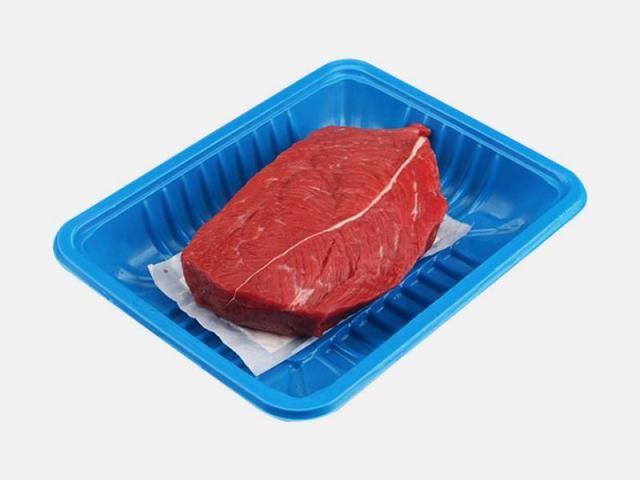
The red liquid under a steak is purge, not blood in the usual sense. A pad can move pooled liquid off the meat and keep the tray base dry; it cannot set, protect or restore the colour of the beef. Colour in fresh beef comes from the state of myoglobin and its exposure to oxygen and the pack atmosphere, none of which a pad controls. So the useful question is not which pad preserves beef colour but how much pad this tray needs — and when a pad is better left out. This guide draws that line for fresh retail trays, aged cuts and case-ready packs.
1. What a pad actually manages in a beef tray
Purge is water and dissolved protein leaving the muscle as it loses water-holding capacity, carrying myoglobin — the pigment that colours both meat and liquid. In a tray it pools along the base, and where the meat sits in it the surface stays wet. Reducing that sustained wet contact is what a pad can honestly do.
- Base pooling. A dry tray base looks clean at display and stops weeping when trays are stacked.
- Surface wetting. Moving liquid off before it soaks the cut shortens the time the surface sits immersed.
- Consumer read. A pad does not make meat look redder; it removes pooled liquid.
If a supplier implies a pad preserves colour or extends bloom, treat it as a claim to question. Colour is managed by chill, oxygen and pack atmosphere; the pad's contribution is drainage. You buy the pad for the liquid load, not as a colour device.
2. Choosing the band: surface, ageing and liquid load
- Steaks and roasts on a short display: low exposed surface and slow release; a light band is often enough under an even chill.
- Sliced and thin-cut beef: far more cut surface per kilogram; step toward a moderate band.
- Ground beef: very high surface area — treat as a moderate-load job.
- Aged cuts: purge rises with wet-ageing and with time in the case; allow a larger band.
Set the band with a purge test on your actual pack: weigh a pad dry, pack it, hold it at your real temperature for your real duration, weigh it again, and look for pooling before the chain ends. Brochure absorbency is usually measured on clean water; meat purge is saltier and protein-rich and behaves differently, so confirm rather than assume.
3. Placement and timing
- Under the cut, centred. Cover most of the tray base with a clear margin; do not let the pad ride up the walls.
- Before the seal on case-ready lines. In a case-ready or MAP pack the pad goes in before sealing — once the film is down nothing more can be added. See our guide to absorbent pads for case-ready and MAP lines.
- Wet face against meat. A top layer that wicks liquid into the core keeps the contact area drier; if it cannot, the contact stays wet. Test rather than assume.
- Keep the window and seal clear. Do not cover the viewing window, and confirm food-contact suitability of every layer with a declaration.
4. Decision table: pad, band, and when to skip
| Situation | Pad decision | Absorbency band | Main reason |
|---|---|---|---|
| Fresh retail steaks, short even chill | light pad — or none when pooling is minimal | light | exudate is low; an oversized pad adds cost and can mark the surface |
| Aged cuts and longer retail hold | pad recommended | moderate | purge rises with ageing and with time in the case |
| Case-ready MAP | pad before sealing | light to moderate | the atmosphere manages colour; the pad handles residual pooling only |
| Foodservice or back-of-house bulk | moderate pad when stacked or transported; often none when meat drains fast | moderate, as needed | function over appearance; skip when meat drains on racks and is used promptly |
Treat the table as a decision aid, not a rule: a purge test on your exact tray, cut and temperature profile is the final judge — including the choice to leave the pad out.
5. Common mistakes
- Buying a pad to keep beef red. Colour is managed by chill, oxygen and atmosphere; a pad does drainage.
- Assuming thicker is better. Oversizing adds cost, can leave pale contact marks, and a bulky pad in a MAP tray eats headspace. Choose by load, not thickness.
- Ignoring food-contact layers. Every layer that touches beef must be food-contact suitable; request the declaration before you commit.
- Putting the pad on top of the product. It traps liquid against the surface, hides the cut and marks the pack.
6. FAQ
Will a beef pad dry the meat out?
No. A pad takes up liquid that has already separated from the muscle; it does not draw moisture out of intact tissue. The visible problem with an oversized pad is different: a large dry surface held against the meat can leave a pale, waterlogged-looking mark where it touched.
Is the pink liquid blood?
No. It is mostly water and protein carrying myoglobin, the pigment that makes meat — and the purge — pink. Purge is released as muscle loses water-holding capacity in chill; its colour is not a reliable sign of quality.
What size and thickness should I choose?
Match length and width to the tray's inner base, leaving a margin, and set the band by a purge test rather than by thickness.
Can a pad be reused?
No. Treat pads as single-use. Once one has absorbed purge it is holding protein-rich liquid; reusing it would keep that liquid in contact with the next portion and break every food-contact assumption. Use a fresh pad per tray.
7. Find the right line
Beef pads are part of the fresh-meat family. See meat absorbent pads for the range and beef absorbent pads for the beef line; if you are new to the inputs behind tray-pad choice, start with our guide to matching soaker pads to the tray and the cut.