
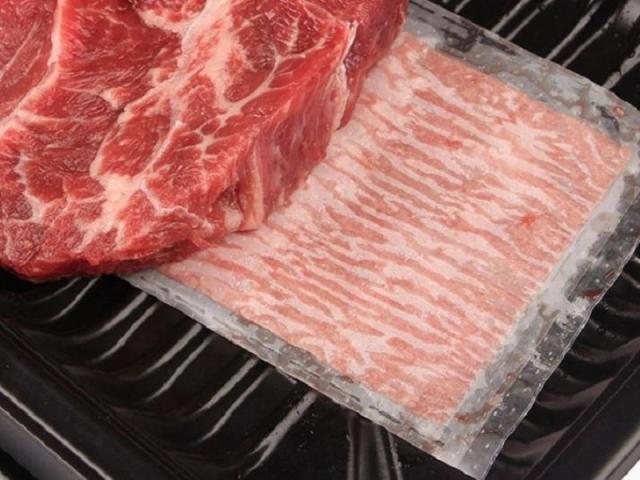
Pork reaches the tray in several forms — whole loins, chops, ground and marinated packs — and each releases liquid at a different rate. Choosing pork absorbent pads is not about ordering the largest pad available; it is about matching absorbency and size to the cut, the tray and the real chain. This guide explains the liquid you are managing and how to judge absorbency and size from a purge test before you specify.
1. What actually collects under pork
The liquid under pork is not blood in the usual sense. It is mostly water with dissolved proteins and a little myoglobin — the pigment that colours pork — released as the meat loses water-holding capacity after slaughter and in chill. Retailers call it purge or drip, and a pad exists to move it off the surface and hold it away from the product.
- Whole-muscle pieces (loin, shoulder): liquid appears at the cut faces and along the base, and collects slowly.
- Chops and sliced packs: more cut surface per kilogram means faster, heavier release.
- Ground pork: mincing opens a large surface, so it releases the most liquid, and early.
- Marinated or injected pork: marinade or brine adds free liquid on top of purge — more volume and more salt, and saltier liquid is absorbed more slowly by a superabsorbent core.
Temperature sets the pace: steady chill slows release; warmth and temperature swings speed it up, so a pad that copes with an even cold chain can be overwhelmed by loading, display or door cycles.
2. Judging absorbency: a light or moderate band, from a test
Do not start from a gram figure on a brochure. Absorbency is usually measured on clean water, while pork purge is saltier and protein-rich. Run the pack under real conditions and read two signals: pooling and pad saturation.
- Visual check: pack a sample tray as you will sell it, hold it at your real temperature and time, then look. Pooling before the end of the chain means capacity is low; a barely damp pad means headroom — or an oversized pad.
- Weight check: weigh the pad dry, pack it, then reweigh after the hold. The difference is what it actually picked up inside your pack — a better basis for a band than a quoted number.
Direction: a light band suits a short, low-exudate job such as fresh chops for local display; step up as exudate, time or temperature swing increases. These are directional bands, not absolutes — confirm any exact gram figure with a purge test on your actual pack.
3. Size and placement against the tray
- Centred beneath the product, covering most of the base with a clear margin to the walls.
- Do not cover the tray vents or the viewing window, and stay clear of the area the film seals against.
- Keep it off the top of the meat: a pad laid over the product traps liquid and marks the pack.
- Match the format to how you pack: sheets for manual packing; a roll may feed better on an automatic line — ask the supplier.
4. Scenario table: a starting point
| Situation | Absorbency to lean toward | Sizing idea | Main risk to watch |
|---|---|---|---|
| Local fresh-cut display (short, even chill) | lighter | cover the base, keep a clear margin | oversized dry pad leaves a pale contact mark |
| Retail divided and tray packs | light to moderate | match the tray inner base, keep a border | under-capacity — pooling at the edges |
| Export or longer cold chain | moderate, with margin | size to the full base, stable centred placement | weep under stacking and temperature swing |
The table is a starting point; confirm each row with a purge test on the exact cut, tray and chain you ship.
5. Common mismatches
- Absorbency too high: a large, dry pad held against the meat can wick surface moisture and leave a pale, marked appearance — a visual outcome, not a safety claim. Size the pad to the job.
- Absorbency too low: pooling at the edges, a wet tray base, weep when trays are stacked.
- Non-food-contact layers: every layer that touches meat must be food-contact suitable; request a declaration.
- Wrong format: hand-cutting a roll at packing speed is inconsistent; pick a format that matches your line.
- Pad on top: it traps liquid, hides the product and marks the pack; it belongs underneath.
6. FAQ
How much absorbency do pork chops really need?
Chops exude little, so a short, even-chill display usually needs only a light pad. Longer hold, warmth or stacking means a step up.
Should the pad go in before or after portioning?
After. Portioning re-opens cut surfaces and adds handling time, so place the pad beneath the finished portion just before sealing. Put in earlier, it sits under loose drip while the tray is worked.
Will a pad be unnecessary if the pack stays properly chilled?
In an even chill the drip is genuinely low, and many short local packs need only a light pad — or none. The failure point is temperature swing: loading, display and door cycles. Judge against your real curve.
What should I check for export pork trays?
Time, stacking and temperature swing all raise the load: lean toward a moderate band with a margin, size to the full base and keep food-contact documentation ready.
7. Find the right line
Pork sits inside the wider fresh-meat family. See meat absorbent pads for the range and pork absorbent pads for the pork line; if you are starting from the tray side, our guide to matching soaker pads to the tray and the cut works through the inputs in order.